REVERTO BLOG
What Is Lead Reactivation? Database Reactivation Explained
Lead reactivation means restarting conversations with old, unconverted leads already in your CRM. How it works, what it is not, and how to run it safely.
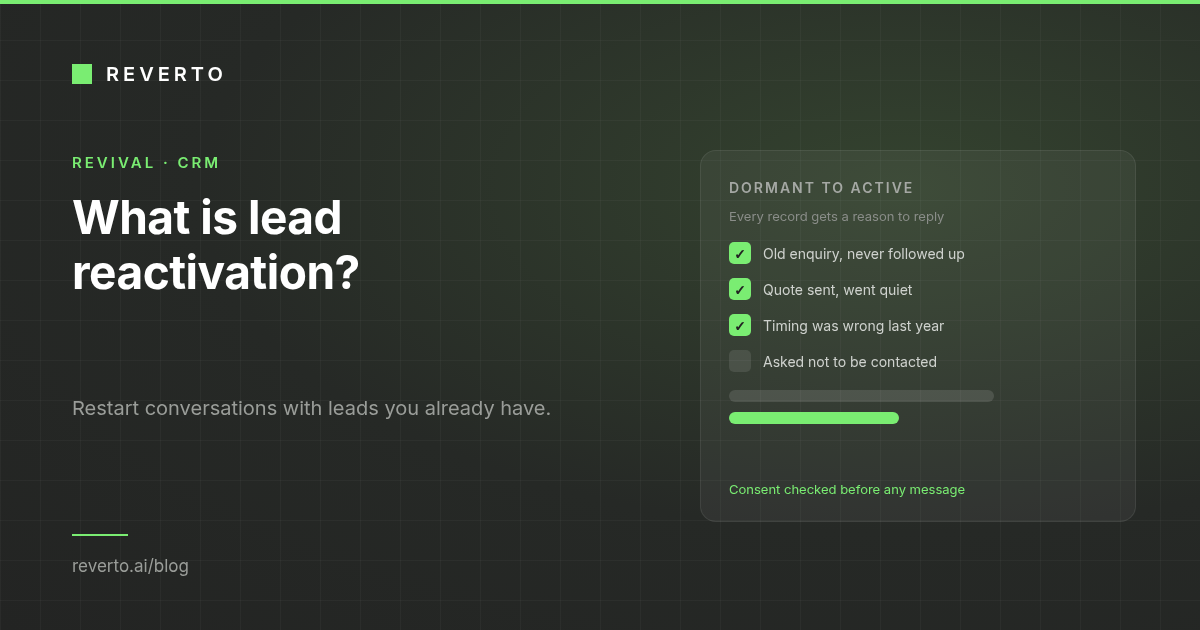
Lead reactivation (also called database reactivation) is the practice of restarting conversations with people already in your CRM who enquired but never bought, went quiet, or were closed out. Instead of buying new leads, you contact existing records with a relevant, permission-based message, qualify whoever replies, and hand interested people to a salesperson.
Reverto AI runs lead reactivation as a managed service, so read this with that in mind. We have named the situations where doing it yourself is the better answer. Figures link to their publishers.
Lead reactivation vs similar terms
Lead reactivation is often confused with nurturing, follow-up and win-back campaigns. The difference is who you are contacting and why. Reactivation targets past enquiries that never converted; nurturing keeps active leads warm; follow-up chases a recent enquiry; win-back targets former customers.
| Term | Who it targets | Goal | Typical trigger |
|---|---|---|---|
| Lead reactivation / database reactivation | Past enquiries and prospects who never converted, often months or years old | Restart a sales conversation and book a meeting | A planned campaign across the CRM, or a timeline the lead gave ("call me in spring") |
| Lead nurturing | Active leads not yet ready to buy | Keep in touch until they are ready | Ongoing sequence from the first enquiry |
| Follow-up | A new or recent enquiry | Get a first or second reply | A fresh form fill, call or quote |
| Win-back / re-engagement | Former customers who stopped buying | Bring a lapsed customer back | Lapsed renewal, cancelled subscription |
| Email list re-engagement | Inactive email subscribers | Confirm interest or clean the list | No opens or clicks over a set period |
For the active-lead side, see B2B lead nurturing.
Why do leads go dormant?
Most dormant records are not bad leads. Common reasons are timing (the person was not ready), a slow or missed first response, follow-up that stopped after one or two attempts, and records that nobody owns once the original salesperson moves on.
Research on response time shows how quickly interest fades. Harvard Business Review research by Oldroyd, McElheran and Elkington (independent; co-author Elkington was CEO of InsideSales.com) found firms that tried to contact a lead within an hour were nearly seven times as likely to qualify it as firms that waited longer than an hour. Leads that missed that window often end up as the dormant records a reactivation campaign targets. More on that in what the speed-to-lead data actually says and how many follow-ups it takes before you stop.
How does a database reactivation campaign work?
A database reactivation campaign works in six steps: segment the old records, check permission, write a specific reason to reply, send in batches your team can answer, qualify and hand over whoever replies, and log every outcome in the CRM.
- Export and segment. Pull records that enquired but never converted. Split them by why they stalled (timing given, went quiet mid-conversation, never engaged) and by age.
- Check permission. Confirm you have a lawful basis to contact each record on each channel. Texting needs prior consent, and US business texting runs on registered 10DLC numbers.
- Write a reason to reply. One short, specific question beats a generic "just checking in". Reference what they originally asked about.
- Send in batches. Contact a volume your team can answer the same day, so replies do not go cold again.
- Qualify and hand over. Ask agreed qualifying questions, then pass interested people to a named salesperson with the full context.
- Log everything in the CRM. Record replies, opt-outs and the next action against the contact, so the database stays usable.
If your records are messy before you start, run the checks in CRM hygiene first.
Which businesses benefit most?
Reactivation pays off where a business already has a large pool of past enquiries and a sale that depends on timing: independent insurance agencies (lapsed quotes and X-dates), real estate brokerages (buyers and sellers who were not ready), home services (estimates that were never booked) and B2B services (stalled proposals).
As a rule of thumb, it is worth a structured approach once you hold hundreds of unconverted records and add more each month.
Is lead reactivation legal?
It can be, if you respect consent and opt-outs. In the US, the Telephone Consumer Protection Act (TCPA, 1991) covers autodialled calls and texts and allows statutory damages of $500 per violation, up to $1,500 if wilful (47 U.S.C. § 227(b)(3)).
The FCC requires businesses to honour a valid opt-out within ten business days, and from 25 November 2026 text senders must still accept all seven standard opt-out keywords, such as STOP and UNSUBSCRIBE (FCC TCPA consent revocation order, published in the Federal Register on 26 October 2026; summary by CommLaw Group). State rules, such as Florida's Telephone Solicitation Act, can be stricter.
This is general information, not legal advice. Check with counsel before texting old records.
DIY, software or a managed service?
There are three ways to run reactivation: build it yourself in your CRM, use self-serve AI or texting software, or hand it to a managed service. The right one depends on whether you have someone with time to build, supervise and answer replies the same day.
| Approach | Best when | Watch out for |
|---|---|---|
| Do it yourself in your CRM (HubSpot workflows, Pipedrive automations, Follow Up Boss action plans) | You have someone who can build, monitor and answer replies, and a modest database | Campaigns stall when that person is busy; replies need same-day handling |
| Self-serve AI or texting software | You want automated conversations and have staff to configure and supervise them | Set-up time, consent management and message quality are still yours |
| An outsourced or managed service | You have the leads but nobody with time to own the follow-up | Check approval controls, CRM write-back, opt-out handling and who answers when a lead replies |
For choosing between tools, see lead nurturing software: how to choose one.
Where Reverto AI fits
Reverto AI is one option in the third group: a managed AI follow-up service that answers, qualifies, follows up and reactivates leads inside a business's existing CRM, then books meetings for its sales team. Its team runs playbooks the client approves, with approval before send, a pause switch, human takeover and an audit log; see how the product works. If you already have a capable in-house operator and a simple database, a CRM-native workflow may be the better fit.
What to measure
Measure reactivation by replies and meetings, not by messages sent. Track these against your own baseline:
- Reply rate by segment and by channel
- Qualified conversations and meetings booked from reactivated records
- Opt-out and complaint rate (a rising rate means the message or audience is wrong)
- Time from reply to human response
- Records cleaned: wrong numbers, duplicates and closed-out contacts removed
Where does this data come from?
Every figure on this page comes from the published sources below, each linked to its publisher.
| Source | Year | Type | Used for |
|---|---|---|---|
| Oldroyd, McElheran & Elkington, "The Short Life of Online Sales Leads", Harvard Business Review | 2011 | Independent; co-author Elkington was CEO of InsideSales.com | Within-an-hour contact nearly seven times as likely to qualify |
| Telephone Consumer Protection Act, 47 U.S.C. § 227(b)(3) | 1991 | Primary (statute) | Statutory damages of $500 per violation, up to $1,500 if wilful |
| FCC TCPA consent revocation order, summary by CommLaw Group | 2026 | Primary rule, independent law-firm summary | Ten-business-day opt-out window; opt-out keywords from 25 November 2026 |
Frequently asked questions
What is the difference between lead reactivation and database reactivation?
They mean the same thing in practice. Database reactivation stresses working the whole CRM; lead reactivation can also describe re-engaging a single stalled lead.
How old is too old for a dormant lead?
There is no fixed cut-off. Records with a stated timeline, a valid phone or email and a lawful basis to contact are worth trying. Very old records with no consent trail are better emailed than texted, or archived.
Should I text or email old leads?
Use the channel the person agreed to. Email is the safer default for old records; text only where you hold prior consent and send from a registered number.
How many messages should a reactivation campaign send?
Keep it short: a first message and a small number of spaced follow-ups, stopping as soon as the person replies or opts out. Then move non-responders to a slower cycle.
Can AI run a database reactivation campaign?
AI can draft and send messages and handle simple replies, but someone still needs to approve the playbook, manage consent and step in when a lead shows real intent. Look for approval before send, a pause switch and human takeover.