REVERTO BLOG
How Many Follow-Ups Before You Stop?
Which sales follow-up statistics hold up and which cannot be sourced. Touch counts, response-time data and the origin of the "80% need five follow-ups" claim, each traced.
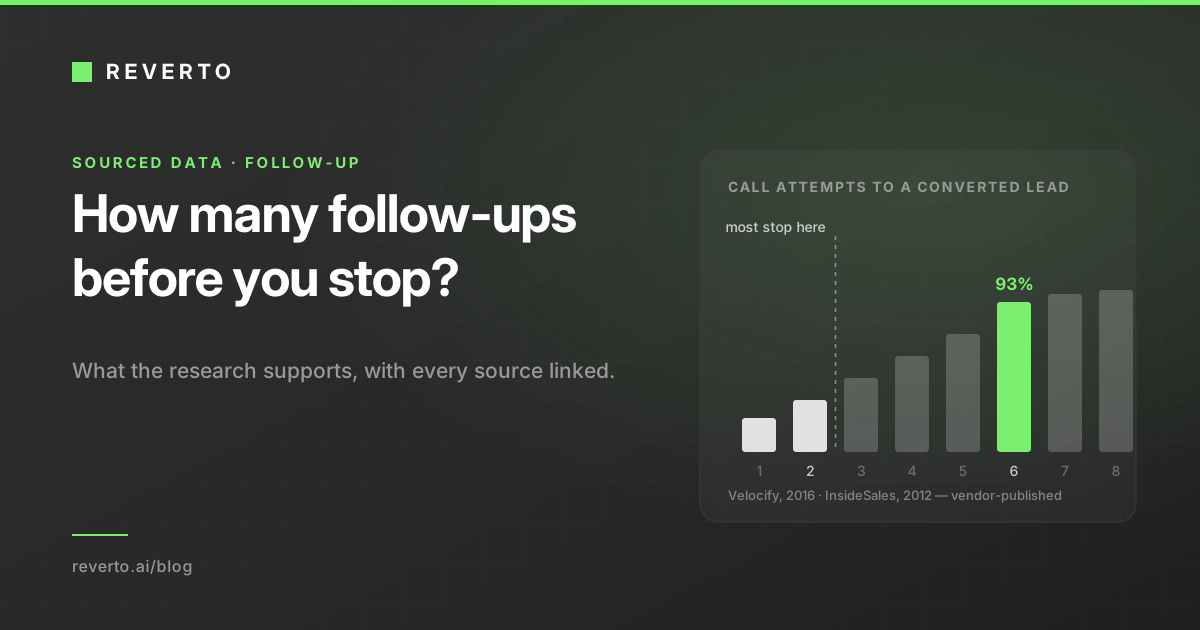
There is no reliable universal number. The best-sourced data points to six call attempts for inbound leads (Velocify, vendor-published) and around eight touches to book a first outbound meeting (RAIN Group, vendor-published). The popular "80% of sales need five follow-ups" claim has no traceable study behind it. Stop when a lead says no, not at a count.
How to read this page. Most follow-up research is published by companies that sell sales software or training. Those figures are marked (vendor-published). Treat the direction as reliable and the absolute numbers as indicative. Independent, peer-reviewed sources are marked (independent).
Which follow-up statistics hold up?
Here is how the most-quoted follow-up statistics hold up once traced to their origin.
Only the statistics with a named study, method and date hold up. The Harvard Business Review response-time study, Velocify's six-call analysis and RAIN Group's eight-touch research can all be traced to published sources. The two most-shared claims, the "80% need five follow-ups" figure and the "63% will not buy for three months" figure, cannot.
The claim that "80% of sales require five follow-ups; 44% of salespeople give up after one" is usually attributed to The Marketing Donut or the National Sales Executive Association. The 110 Sales and Marketing Statistics PDF repeats it, but no original study, sample size, method or publication date has been found. It remains unverifiable, circulating through statistics roundups that cite each other.
The claim that "63% of people requesting information will not purchase for at least three months; 20% take more than 12 months" is also credited to The Marketing Donut in the same statistics PDF and by BenchmarkOne. No original study has been found, so these figures remain unverifiable too.
The average response time of 42 hours to a web lead is traceable to Oldroyd, McElheran and Elkington's March 2011 article, "The Short Life of Online Sales Leads" in Harvard Business Review. This independent research is frequently misquoted as reporting 47 hours.
The finding that 93% of converted leads were reached by the sixth call attempt comes from Velocify's analysis of about 3.5 million leads, reported in 2016. It is traceable to The Ultimate Contact Strategy PDF and the National Law Review summary. This is vendor-published research.
The finding that it takes an average of eight touches to secure a first meeting comes from RAIN Group's prospecting research, based on 488 buyers and 489 sellers. The study dates to approximately 2018, with the linked article published in August 2025. This is also vendor-published research.
Most sales-statistics pages repeat the unverifiable claims without checking them. If you can produce a primary source for the first two, send it to us and we will update this page.
Is the "80% of sales require 5 follow-ups" statistic real?
No, not as far as anyone can show. The figure is usually credited to The Marketing Donut or the National Sales Executive Association, but no study, sample size, method or publication date has been found for either. It circulates through statistics roundups that cite each other, so treat it as folklore rather than research.
The claim usually reads: "80% of sales require five follow-up calls after the meeting, yet 44% of salespeople give up after one." We traced it as far as the public record allows.
- Statistics roundups credit it to The Marketing Donut, a UK small-business advice site. One example is a widely shared 110 Sales and Marketing Statistics PDF, which lists it with only "Source: The Marketing Donut".
- Other versions credit the National Sales Executive Association. We found no study, report or archived page from that organisation containing the figure.
- An October 2015 roundup, 21 Mind-Blowing Sales Stats (SBI), repeats related figures without a primary source.
- The trail runs cold there. No sample size, method, year or original document has been found. A 2026 review of sales statistics by Fluid CRM reached the same conclusion.
The underlying idea, that most deals need more touches than most reps send, is supported by the sourced research below. The specific "80% / five" figure is not.
How many follow-ups does the research actually support?
The research supports far more attempts than most teams make. Conversion keeps climbing until about the sixth call attempt, yet reps in the InsideSales.com data made an average of 1.3 call attempts before giving up. No source that published its method supports stopping after one or two attempts.
| Finding | Source | Date | Type |
|---|---|---|---|
| 93% of converted leads were reached by the sixth call attempt. Leads needing more than seven calls were 45% less likely to convert. | Velocify, The Ultimate Contact Strategy (about 3.5 million leads), summarised by the National Law Review | 2016 | Vendor-published |
| Roughly half of leads in earlier Velocify data were called only once. | Same Velocify summary, National Law Review | 2016 | Vendor-published |
| It takes an average of eight touches to secure a first meeting with a new prospect. Top performers need about five. | RAIN Group, Top Performance in Sales Prospecting (488 buyers, 489 sellers) | Study c. 2018; article August 2025 | Vendor-published |
| Between 2008 and 2012, reps made an average of 1.3 call attempts to a new lead before giving up. | InsideSales.com research, cited by Geckoboard | 2012 | Vendor-published, secondary citation |
What this means: every source that published its method finds the same pattern. Most leads get one or two attempts, while conversion keeps climbing until about the sixth. No source supports stopping after one or two attempts.
Velocify's 2016 analysis of about 3.5 million leads found that 93% of converted leads were reached by the sixth call attempt (vendor-published).
How many touches does it take to make a sale?
It depends on what you count. RAIN Group reports an average of eight touches of any kind to secure a first meeting with a new prospect, while Velocify found 93% of converted inbound leads were reached by the sixth call attempt. Both are vendor-published, and because they measure different things, neither number is a universal rule.
RAIN Group's research, based on 488 buyers and 489 sellers, found that it takes an average of eight touches to secure a first meeting with a new prospect (vendor-published, study c. 2018).
The six-call and eight-touch findings are not in conflict. Velocify counts call attempts to an inbound lead: someone who has already enquired and is expecting to hear back. RAIN Group counts touchpoints of every kind, including calls, emails and social messages, needed to win a first meeting with a prospect who has not asked to be contacted.
So the unit matters. A team that compares its own activity with either number has to decide first whether it is counting call attempts or total touches, and whether its leads asked to be contacted.
How fast should you respond to a new lead?
Respond within the hour at the latest, and within minutes where you can. Harvard Business Review found firms contacting a lead within an hour were nearly seven times as likely to qualify it as firms waiting one hour longer. Yet the companies it tested took an average of 42 hours to respond.
Closing that gap is what speed to lead means in practice.
- Within one hour: nearly 7× more likely to qualify. Firms that tried to contact a lead within an hour were nearly seven times as likely to qualify it as firms that waited one hour longer. They were more than 60 times as likely to qualify it as firms that waited 24 hours or more. Source: Oldroyd, McElheran and Elkington, "The Short Life of Online Sales Leads", Harvard Business Review, March 2011 (independent, peer-reviewed; co-author Elkington was CEO of InsideSales.com). The study is listed on BYU ScholarsArchive.
- Average response: 42 hours. The same HBR article reports that the companies it tested took an average of 42 hours to respond to a web lead. This is often misquoted as 47 hours.
- First minute: +391% conversion. Calling within one minute raised conversion by 391% in Velocify's lead data, as reported by Solar Power World, October 2015 (vendor-published).
- 7% answered within five minutes. In February 2017, Drift sent contact requests to 433 companies. Only 7% responded within five minutes, and 55% had not responded within five business days. Source: Drift, via Medium, 2017 (vendor-published).
- 13% never called back. In a 2014 secret-shopper test of companies using a sales CRM, 13% of enquirers never heard from a sales rep. Source: Velocify press release, August 2014 (vendor-published).
Are leads older than 90 days still worth working?
Often, yes. Leads that go quiet after 90 days have usually been contacted very little, because most leads receive only one or two attempts. The popular claim that 63% of enquirers will not buy for three months cannot be traced, but the low-contact pattern in the Velocify and InsideSales.com data is well sourced.
The most-quoted figure is that "63% of people requesting information will not purchase for at least three months, and 20% will take more than 12 months". Like the follow-up claim, it is credited to The Marketing Donut in roundups such as the 110 statistics PDF and BenchmarkOne. We could not find the original study.
What can be sourced is the other side of the equation. Leads that go quiet after 90 days have usually been contacted very little. The one-or-two-attempt pattern in the Velocify and InsideSales data above means most dormant leads went quiet because nobody kept following up, not because they said no.
Do aged leads still close, by industry?
There is no independent answer. We found no published, independent close rates for aged leads by industry. The only figures come from companies that sell aged leads, such as a worked example of 2% on aged insurance leads against 15% on fresh ones. Treat those as one seller's view and test your own database.
We found no independent, published close rates for aged leads broken down by industry. The only figures available come from companies that sell aged leads, which have an obvious interest in the answer.
- Aged Lead Store gives a worked example with a 2% close rate on aged insurance leads, against 15% on fresh leads (Aged Lead Store, March 2026, vendor-published, seller of aged leads).
- How To Work Leads publishes insurance, mortgage, solar and home-improvement benchmarks drawn from its own agents (How To Work Leads, February 2026, vendor-published, same operator).
Treat these as one seller's view, not an industry benchmark. Your own CRM is the only reliable source. Segment dormant leads by age and source, work a sample, and measure the result.
What does an unworked enquiry cost?
No credible study puts a single dollar figure on it, so calculate it for your own business. Multiply unworked enquiries by your enquiry-to-sale rate and average deal value, then add what you already spent generating those leads. The sourced data shows that many paid-for enquiries never get a reply at all.
No credible study gives a single dollar figure for this, and any page that quotes one should be treated with suspicion. The cost is easier to calculate for your own business:
Cost of unworked enquiries per month
  = unworked enquiries × enquiry-to-sale rate × average deal value
  + unworked enquiries × cost per lead (spend already made)
The sourced inputs above show how big the gap can be. Around a quarter of companies in the HBR sample never responded, 13% of CRM users in Velocify's test never called back, and 55% of companies in Drift's test had not replied within five business days. Every one of those leads was paid for.
Where does this data come from?
Every figure on this page comes from a named, linked source, checked against the publisher's own page or the nearest available copy on 29 September 2026. Each source is marked independent, vendor-published, secondary or roundup. Figures credited only to a roundup, with no traceable original, are marked unverifiable and not used as evidence.
Each figure on this page was checked against the publisher's own page, or the nearest available copy, on 29 September 2026. Figures credited only to a roundup, with no traceable original, are marked unverifiable and are not used as evidence.
| Source | Year | Type | Used for |
|---|---|---|---|
| Oldroyd, McElheran & Elkington, HBR | 2011 | Independent (peer-reviewed; industry co-author) | Response-time decay, 42-hour average |
| BYU ScholarsArchive record | 2011 | Independent | Publication details |
| Velocify, Ultimate Contact Strategy | 2016 | Vendor-published | Six-call finding |
| National Law Review summary of Velocify | 2016 | Secondary (of vendor data) | 93% by sixth call; single-call share |
| Velocify CRM secret-shopper study | 2014 | Vendor-published | 13% never contacted |
| Solar Power World on Velocify | 2015 | Secondary (of vendor data) | +391% first-minute call |
| RAIN Group prospecting research | c. 2018 / 2025 | Vendor-published | Eight touches to first meeting |
| Drift response-time test | 2017 | Vendor-published | 7% within five minutes |
| Geckoboard citing InsideSales.com | 2012 data | Secondary (of vendor data) | 1.3 call attempts |
| Aged Lead Store | 2026 | Vendor-published (lead seller) | Aged lead close-rate example |
| How To Work Leads | 2026 | Vendor-published (lead seller) | Aged lead benchmarks |
| 110 Sales and Marketing Statistics PDF | c. 2016 | Roundup | Tracing the 80% and 63% claims (unverifiable) |
| SBI, 21 Mind-Blowing Sales Stats | 2015 | Roundup | Tracing circulation |
| Fluid CRM, Sales Statistics 2026 | 2026 | Vendor-published review | Corroborating the dead ends |
This page is reviewed every quarter. If you know a primary source we have missed, especially for the 80% or 63% figures, tell us and we will update the page.
Frequently asked questions
How many times should you follow up with a lead before giving up?
For inbound leads, plan on at least six call attempts plus email. Velocify's analysis of nearly 3.5 million leads found 93% of converted leads were reached by the sixth call. For outbound, RAIN Group reports an average of eight touches to book a first meeting. Both are vendor-published, so treat the numbers as indicative.
Is the 80% of sales require 5 follow-ups statistic real?
It cannot be verified. The figure is usually credited to Marketing Donut or the National Sales Executive Association, but no study, sample size or publication date has been found for either. It spread through statistics roundups that cite each other. Treat it as folklore, not data, and do not quote it as research.
How fast should you respond to a new sales lead?
Within the hour at the latest, and within five minutes where possible. A Harvard Business Review study of 2,241 US companies found firms contacting leads within an hour were nearly seven times as likely to qualify them as firms waiting one hour longer, and over sixty times as likely as those waiting a day.
Are leads older than 90 days still worth working?
Often yes, but expect lower conversion than fresh leads. Many buyers who enquire are not ready to buy for months, and most leads receive very few contact attempts. There is no independent close-rate data for aged leads by industry; the only published figures come from companies that sell aged leads, so test with your own database.
How many touches does it take to make a sale?
RAIN Group reports an average of eight touches to secure a first meeting with a new prospect, with top performers needing about five. That counts touches of any kind. Velocify's inbound data counts call attempts instead and found 93% of converted leads were reached by the sixth call. Both are vendor-published, so treat them as indicative.
What is a reasonable follow-up cadence for inbound leads?
Fast first, then persistent. Respond within minutes where possible, then keep attempting across channels rather than stopping at one or two. The sourced data shows conversion continuing to climb to about the sixth attempt, while most teams stop long before that. Stop when a lead says no, not at a count.