REVERTO BLOG
CRM Hygiene: Why a Full Database Stops Converting
What CRM hygiene actually means, how to tell which records are dead and which are dormant, and what to do with the closed-lost pile instead of deleting it.
CRM hygiene is the ongoing work of keeping records accurate enough to act on: correct contact details, honest stage data, recorded consent, and a clear distinction between a lead that is dead and one that is merely dormant. Most hygiene advice is about deleting things. The more valuable half is working out which records are still worth a conversation, and why they stopped in the first place.
What is CRM hygiene?
CRM hygiene means keeping every record accurate enough that someone could act on it today. It has four components: contact accuracy, stage accuracy, consent records and classification. Most teams do the first one, fixing bounced emails and wrong numbers, and skip the other three, which is why a tidy-looking CRM can still produce very little revenue.
- Contact accuracy: the email, phone and company details are current and reach the right person.
- Stage accuracy: the stage reflects what is actually happening, not what was true three months ago.
- Consent records: each contact has a documented source showing how and when they agreed to hear from you.
- Classification: every stopped conversation is labelled as finished or dormant, with the reason it stopped.
Why a full CRM stops producing
A CRM stops producing when the records in it can no longer be acted on with confidence. Four causes do most of the damage: contacts change jobs, nobody is paid to close a deal as lost, records pile up with no consent trail, and nothing separates a buyer who said no from one nobody called twice.
- Contacts change jobs. The person who enquired moves on, and the record quietly points at nobody.
- Nobody is paid to close a deal as lost. Deals sit open because marking them lost costs the rep and gains them nothing.
- Records accumulate with no consent trail. Imports, events and old forms add contacts nobody can say they have permission to contact.
- Nothing separates "said no" from "nobody called twice". Both end up in the same stale pile.
The last cause is more common than it looks. InsideSales.com research cited by Geckoboard (vendor-published, secondary citation) found reps averaged 1.3 call attempts before giving up, in data from 2008 to 2012. A lead abandoned after one attempt was never really worked. For how many attempts actually make sense, see how many follow-ups before you stop.
Dead or dormant: how to tell the difference
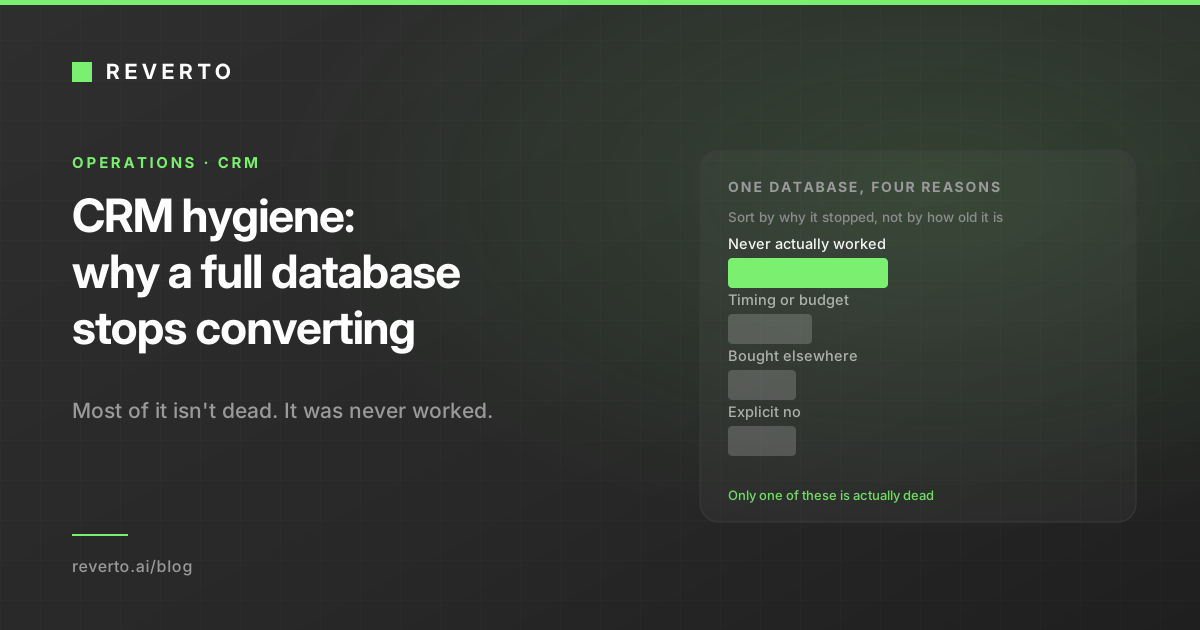
Age is a poor signal for whether a record is finished. The reason the conversation stopped is a good one. Sort stopped records into four categories: explicit no, bought elsewhere, timing or budget, and never actually worked. Each category calls for a different action, and the last one is usually the largest and the best place to start.
| Why it stopped | What it means | What to do |
|---|---|---|
| Explicit no or opt-out | The person has asked not to be contacted | Suppress the record |
| Bought elsewhere | They solved the problem with someone else | Revisit around their renewal |
| Timing or budget | The need was real but the moment was wrong | Set a dated reason to return |
| Never actually worked | Nobody followed up properly | Start here |
The "never actually worked" group grows because follow-up stops early. Velocify's "The Ultimate Contact Strategy" (2016, summarised by the National Law Review, vendor-published) found 93% of converted leads were reached by the sixth call attempt. A lead dropped after one or two attempts tells you about your process, not about the buyer. Working that group is what dormant lead reactivation is about.
CRM data quality: what to measure
CRM data quality is best measured with a handful of checks you can run this week and repeat. There are no reliable industry benchmarks for these figures, so treat your first results as a baseline and track them against themselves over time. Six checks cover the four components of hygiene and show where the problems actually sit.
- Valid email percentage: the share of contacts with an email address that does not bounce.
- Phone percentage: the share of contacts with a phone number on record.
- Stale open deals: open deals with no logged activity in the last 90 days.
- Closed-lost reasons: the share of closed-lost deals with a reason recorded.
- Consent coverage: the share of contacts with a documented consent source.
- Duplicate rate: the share of records that duplicate another person or company.
Run the same six checks on the same date each cycle. The direction of change matters more than any single number. Bounced addresses also damage email sending reputation; see the email deliverability checklist.
CRM cleanup: what to delete and what to keep
Delete less than you think. CRM cleanup is right for undeliverable addresses, opt-outs and duplicates, because those records cannot be acted on or should not be. It is wrong for old enquiries that were never worked, because those people asked about what you sell once and the reason they went quiet is usually unknown.
- Delete or suppress: hard-bounced addresses, opt-outs and unsubscribes, and duplicate records (merge them first).
- Keep and classify: old enquiries, stalled proposals and closed-lost deals with a timing or budget reason.
Personal data also carries retention and erasure obligations that depend on where you and your contacts are based. Check what applies to you before deleting or keeping records; this article is not legal advice.
What closed lost actually means
Closed lost records that a deal stopped, not that it was refused. The stage tells you the deal is no longer open; the reason field tells you what to do next. A closed-lost deal marked "budget" or "timing" is one of the most useful records in a CRM, because it comes with a dated reason to make contact again.
That only works if the reason is recorded. A closed-lost pile with no reasons looks the same whether buyers said no or nobody called back. Make the reason field required (the reply itself often tells you the reason; see B2B buying signals), keep the options short, and add a date to return for timing and budget losses. For long B2B cycles where stalled proposals are common, see B2B lead nurturing and our page for B2B services firms.
Pipeline hygiene vs CRM hygiene
Pipeline hygiene is about open deals: keeping stages, values and close dates honest so the forecast can be trusted. CRM hygiene covers the whole database, including every closed and stopped record, so it stays usable. Teams usually do the first and neglect the second, because only pipeline hygiene shows up in a forecast meeting.
The cost of neglecting CRM hygiene is quieter. Response speed shows how quickly attention fades: the Harvard Business Review study by Oldroyd, McElheran and Elkington (2011, independent; co-author Elkington was CEO of InsideSales.com) found firms that contacted a lead within an hour were about 7 times more likely to qualify it, against an average response time of 42 hours. Velocify's August 2014 secret-shopper study (vendor-published) found 13% of enquirers never heard from a rep at all. Those enquiries are still in somebody's CRM.
How often should you clean your CRM?
The mechanical parts of CRM hygiene, such as bounces, opt-outs and duplicates, should run continuously, ideally automatically. Classification needs a defined cycle, such as quarterly, where someone reviews stopped records and sorts them. A one-off cleanup decays as soon as it ends; the lasting fix is a rule for what happens when a conversation stops.
A workable rule: whenever a deal or enquiry stops, the record gets a reason from a short list and, where the reason is timing or budget, a date to return. That turns cleanup from an annual project into a habit that keeps the database usable.
Where Reverto AI fits
Reverto AI is a managed conversion layer. It works the leads a company already has, including the dormant, never-worked records a hygiene review uncovers, and the Reverto AI team operates it. It is not a data cleansing or enrichment tool and will not fix contact details or merge duplicates. If your problem is bad data rather than unworked leads, a data-quality tool is the better fit.
Where does this data come from?
Every figure on this page comes from the four published sources below, each linked to its publisher. Studies published by companies selling sales software are marked vendor-published. No data-decay rate or database-quality benchmark appears on this page, because none of these sources measures one.
| Source | Year | Type | Used for |
|---|---|---|---|
| Oldroyd, McElheran & Elkington, "The Short Life of Online Sales Leads", Harvard Business Review | 2011 | Independent; co-author Elkington was CEO of InsideSales.com | Within-an-hour contact about 7 times more likely to qualify; 42-hour average response |
| Velocify, "The Ultimate Contact Strategy", summarised by the National Law Review | 2016 | Vendor-published | 93% of converted leads reached by the sixth call attempt |
| InsideSales.com research, cited by Geckoboard | 2008 to 2012 data | Vendor-published, secondary citation | Reps averaged 1.3 attempts before giving up |
| Velocify secret-shopper study | 2014 | Vendor-published | 13% of enquirers never heard from a rep |
Frequently asked questions
What is CRM hygiene?
CRM hygiene is the ongoing work of keeping CRM records accurate enough to act on. It covers four things: correct contact details, stage data that reflects reality, a recorded consent source for each contact, and a clear label separating records that are finished from records that simply stopped. Most teams handle contact details and skip the other three.
How do you know if a lead is dead or just dormant?
Look at why the conversation stopped, not how old the record is. An explicit no or an opt-out means the lead is finished and should be suppressed. Bought elsewhere means revisit at renewal. Timing or budget gives you a dated reason to return. A lead that was never properly worked is dormant, and usually the best place to start.
Should you delete old leads from your CRM?
Usually not. Deleting is right for undeliverable addresses, opt-outs and duplicates. It is wrong for old enquiries nobody worked properly, because those people raised their hand once and may still need what you sell. Check your own retention and erasure obligations before deleting or keeping personal data; this article is not legal advice.
What does closed lost mean?
Closed lost means a deal stopped moving and someone marked it finished. It does not mean the buyer refused. The reason recorded alongside it matters more than the stage itself: "budget" or "timing" is a dated reason to get back in touch, while "chose a competitor" points to their renewal date and "not interested" means leave it.
How often should you clean your CRM?
Mechanical checks such as bounced emails, opt-outs and duplicates should run continuously, ideally automatically. Classification, deciding which records are finished and which are dormant, works best on a defined cycle such as quarterly. A one-off cleanup decays quickly; the lasting fix is a rule for what happens to a record whenever a conversation stops.