REVERTO BLOG
B2B Lead Nurturing: A Practical Guide
How B2B lead nurturing works when the buying cycle outlasts the follow-up - segmenting by why a deal stalled, choosing timing and channels, and knowing when to stop.
Figures on this page come from published research, each linked to its publisher. Studies published by companies selling sales software are marked (vendor-published). Independent, peer-reviewed sources are marked (independent).
B2B lead nurturing is the work of keeping a lead engaged across a buying cycle that is longer than anyone's attention span. It differs from B2C less in the messages than in the duration and the number of people involved. The common failure is not bad content. It is a process that runs out before the buyer is ready.
What is B2B lead nurturing?
B2B lead nurturing is keeping an existing lead engaged between the first enquiry and a buying conversation, over a cycle measured in months rather than days. It is not prospecting, which means contacting someone new, and it is not follow-up on a live deal, which is a shorter and more urgent loop.
Put plainly, lead nurturing in B2B starts from a lead you already have. Someone enquired, downloaded something, asked for a quote or took a first call, and then the conversation stalled. Nurturing is what happens between that stall and the point where they are ready to talk about buying.
How is B2B lead nurturing different from B2C?
The messages in B2B and B2C nurturing are often similar. What differs is the conditions around them: how long the cycle lasts, how many people are involved, what triggers a purchase, and whether a person should step in before the sale. Each of these changes how the process needs to be designed.
- Cycle length. A B2B decision can take months or longer, so the process has to outlast the first burst of interest.
- Several people, one decision. Buying involves more than one person, and those people may change roles or leave mid-cycle. The contact you started with may not be the one who signs.
- Dated triggers. The reason to buy is often a budget, a contract end or a renewal date rather than a mood or an impulse.
- A human at the right moment. Deal values usually justify a person taking over once the buyer is ready, instead of automating all the way to a purchase.
Why B2B lead nurturing usually fails
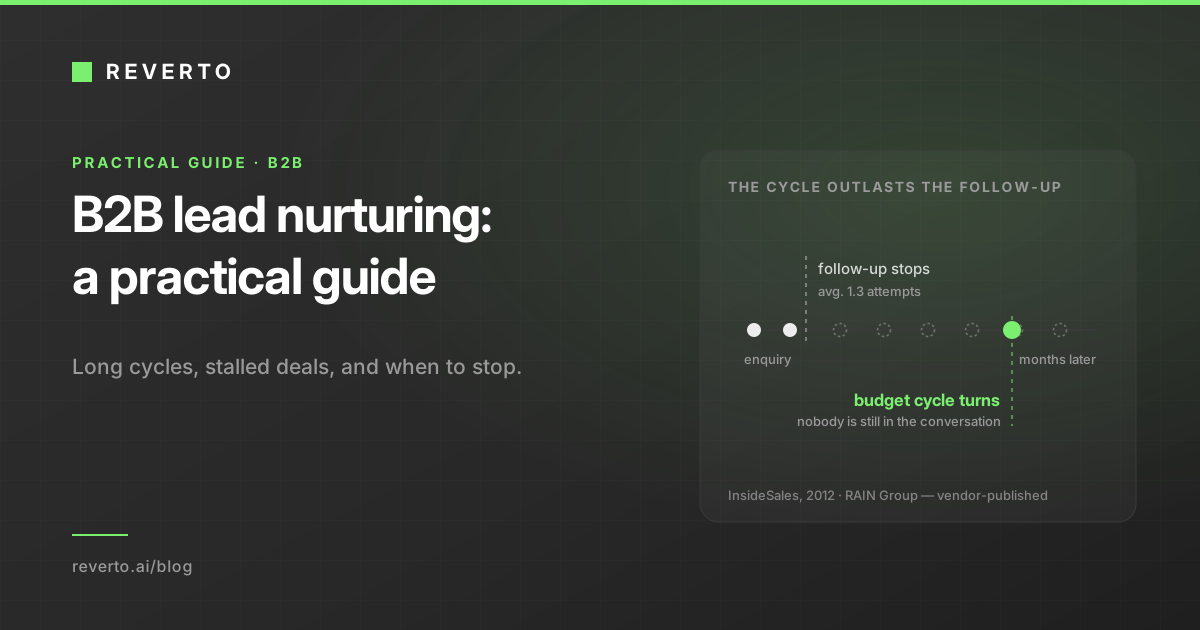
B2B lead nurturing usually fails because the follow-up stops long before the buying cycle does. Published research shows reps giving up after very few attempts, while the same research shows conversions arriving several attempts later. The gap between those two numbers is where most stalled B2B leads are lost.
InsideSales.com research, cited by Geckoboard (vendor-published, secondary citation), found that between 2008 and 2012 reps averaged 1.3 call attempts to a new lead before giving up.
Against that, Velocify's 2016 study of about 3.5 million leads, summarised by the National Law Review (vendor-published), found 93% of converted leads were reached by the sixth call attempt. RAIN Group's research with 488 buyers and 489 sellers (vendor-published) reports an average of eight touches to secure a first meeting with a new prospect, and about five for top performers.
The process stops at the first or second attempt, while the meeting tends to come much later. For the full data on attempt counts, see how many follow-ups to make before you stop.
B2B lead nurturing strategies that account for a long cycle
The B2B lead nurturing strategies that work over a long cycle share one idea: each contact should have a reason that belongs to the buyer, not to your pipeline review. That means sorting leads by why they stalled, timing contact to their calendar, re-qualifying, joining channels into one conversation and agreeing the handover in advance.
Segment by why the conversation stopped
The age of a lead says little about what it needs. No budget, no authority, wrong timing and went quiet are different problems, and each needs a different message. A lead with no budget needs a reason to come back when budget opens; a lead that went quiet may only need a direct question.
Work to the buyer's calendar
Contract renewals, budget cycles and fiscal year ends are dated reasons to get in touch. They have nothing to do with your quarter, which is exactly why a message tied to them reads as relevant rather than as chasing.
Re-qualify rather than re-pitch
The criteria that mattered at the first enquiry may no longer apply, and the person may have changed role or company. Asking what has changed is usually more useful than repeating the original pitch.
Use more than one channel, as one conversation
A thread can move between email and another channel while staying on one record. Running parallel sequences instead means the buyer experiences what feel like separate companies contacting them. This is the principle behind persistent follow-up that carries one conversation across channels.
Define the handover point before launch
Decide in advance what a reply has to contain before a person takes over: a stated need, a timeframe, a named decision-maker. Without that rule, replies either sit unanswered or reach sales too early.
B2B lead nurturing best practices for timing and cadence
The main B2B lead nurturing best practice for timing is to separate the first contact from everything after it. Speed matters at first contact, where research shows a sharp drop-off within hours. After that, patience matters more than speed, and there is no single correct interval between messages.
For first contact, Oldroyd, McElheran and Elkington's "The Short Life of Online Sales Leads" in Harvard Business Review, March 2011 (independent, peer-reviewed; co-author Elkington was CEO of InsideSales.com), found firms contacting a lead within an hour were nearly seven times as likely to qualify it as firms waiting one hour longer. The companies tested averaged 42 hours to respond to a web lead.
Other research points the same way, though it is vendor-published. Drift's 2017 test of 433 companies found 7% responded within five minutes and 55% had not responded within five business days. Velocify's August 2014 secret-shopper study found 13% of enquirers never heard from a sales rep. More detail is in our speed to lead statistics.
After the first contact, spacing is a judgement, not a formula. The test for each message is whether it has a reason attached: a date in the buyer's calendar, a change in their situation, a question that moves the conversation on. A message with no reason is just a reminder that you exist.
B2B lead nurturing ideas that do not require new content
Good B2B lead nurturing ideas often come from records a firm already holds, not from new content. Closed-lost deals, quiet proposals, contacts who changed jobs, renewal dates, single-touch enquiries and unworked event lists are all leads with a known history and a natural reason to get back in touch.
- The closed-lost list. The reason a deal was lost is often a timing or budget reason that has since changed.
- Proposals that went quiet. A proposal already contains the buyer's stated need; asking whether it still applies is a simple opening.
- Contacts who changed jobs. A former contact in a new role may be a new buyer, and their replacement is a new conversation.
- Past customers with renewal dates. A renewal is a dated reason to talk, well before it arrives.
- Enquiries that never got a second touch. These leads asked for something and heard back once, or not at all.
- Event or webinar lists that were never worked. Attendees showed interest in a topic; few were ever followed up individually.
Working these older records systematically is what dormant lead reactivation is built for.
Where AI for B2B lead nurturing helps, and where it does not
AI for B2B lead nurturing helps most with coverage: contacting more of the list, more consistently, and reading replies well enough to decide the next step. It does not help with a weak offer, a list with no consent record, or a decision that needs a senior person in the room.
When evaluating this, ask one question: does the AI only generate message copy inside a fixed sequence, or does it change what happens next based on what the buyer said? The first saves writing time. The second changes how many replies get handled. If the question is which tool, our guide to choosing lead nurturing software covers it.
B2B lead nurturing marketing: who owns it
B2B lead nurturing marketing sits between marketing and sales, and the most common failure is organisational rather than technical: neither team owns the middle. Marketing hands leads over, sales works the ones that are ready, and the stalled leads in between belong to nobody in particular.
There are three usual arrangements. Marketing owns nurturing until a lead becomes a marketing-qualified lead, then hands it to sales. Sales owns it after the first conversation, alongside live deals. Or nobody owns it, and stalled leads simply age in the CRM. Whichever arrangement a firm chooses, the stalled middle needs a named owner. In B2B services, where proposals and long decision cycles are normal, that gap is often where the most leads sit.
How long should a B2B nurture sequence run?
A B2B nurture sequence should run longer than most teams run them, and it should stop on a signal rather than a count. Stop on an explicit no, an opt-out, or a confirmed change that removes the need. Do not stop because a set number of attempts has been reached.
For context, Velocify (vendor-published) found 93% of converted leads were reached by the sixth call attempt, and that leads needing more than seven calls were 45% less likely to convert. RAIN Group (vendor-published) reports an average of eight touches to secure a first meeting. Neither figure is a stopping rule; both show that conversations commonly need more attempts than reps make.
Where does this data come from?
Every figure on this page comes from the six sources below, and nothing else. Each row links to the publisher's own page and states whether the research is independent or published by a company that sells sales software, so you can weigh each figure accordingly before relying on it.
| Source | Year | Type | Used for |
|---|---|---|---|
| Oldroyd, McElheran & Elkington, "The Short Life of Online Sales Leads", Harvard Business Review | 2011 | Independent, peer-reviewed (co-author Elkington was CEO of InsideSales.com) | Nearly seven times as likely to qualify within an hour; 42-hour average response |
| RAIN Group, "Top Performance in Sales Prospecting" | Not stated | Vendor-published | Eight touches on average to a first meeting; about five for top performers |
| Velocify, "The Ultimate Contact Strategy", via National Law Review | 2016 | Vendor-published | 93% reached by the sixth call attempt; 45% less likely after more than seven calls |
| InsideSales.com research, cited by Geckoboard | 2008–2012 | Vendor-published, secondary citation | 1.3 call attempts before giving up |
| Drift response-time test | 2017 | Vendor-published | 7% within five minutes; 55% no response within five business days |
| Velocify secret-shopper study | 2014 | Vendor-published | 13% never heard from a sales rep |
Frequently asked questions
What is B2B lead nurturing?
B2B lead nurturing is the work of keeping an existing business lead engaged between the first enquiry and a buying conversation. The cycle is usually measured in months rather than days, and more than one person is often involved. It starts from a lead you already have, which separates it from prospecting, and it runs longer and slower than follow-up on a live deal.
How is B2B lead nurturing different from B2C?
The messages are less different than the conditions. B2B cycles run longer, decisions involve several people who may change roles along the way, and the trigger to buy is often a budget or contract date rather than a mood. Deal values are usually high enough that a person should take over at the right moment instead of automating all the way to a purchase.
How long should a B2B nurture sequence run?
Longer than most teams run them. The stopping rule should be a signal, not a count: stop on an explicit no, an opt-out, or a confirmed change that removes the need. Velocify (vendor-published) found 93% of converted leads were reached by the sixth call attempt, while RAIN Group (vendor-published) reports an average of eight touches to secure a first meeting.
What are the best B2B lead nurturing strategies for a long sales cycle?
Segment leads by why the conversation stopped rather than by age. Time contact to the buyer's calendar, such as renewals and budget cycles. Re-qualify instead of re-pitching, because roles and needs change. Run several channels as one conversation on one record. And agree before launch what a reply has to contain before a person takes over the conversation.
Can AI handle B2B lead nurturing on its own?
Not entirely. AI helps with coverage: contacting more of the list, more consistently, and reading replies well enough to choose the next step. It cannot fix a weak offer, a list with no consent record, or a decision that needs a senior person in the room. The useful question is whether it changes what happens next based on the reply, or only writes copy.