REVERTO BLOG
Lead Nurturing Software: How to Choose One
A comparison of the three kinds of lead nurturing software, what each is built for, who has to operate it, and which one fits a team that already has a CRM.
Reverto is one of the options compared here. The categories below are described as they work, and we name where another category fits better.
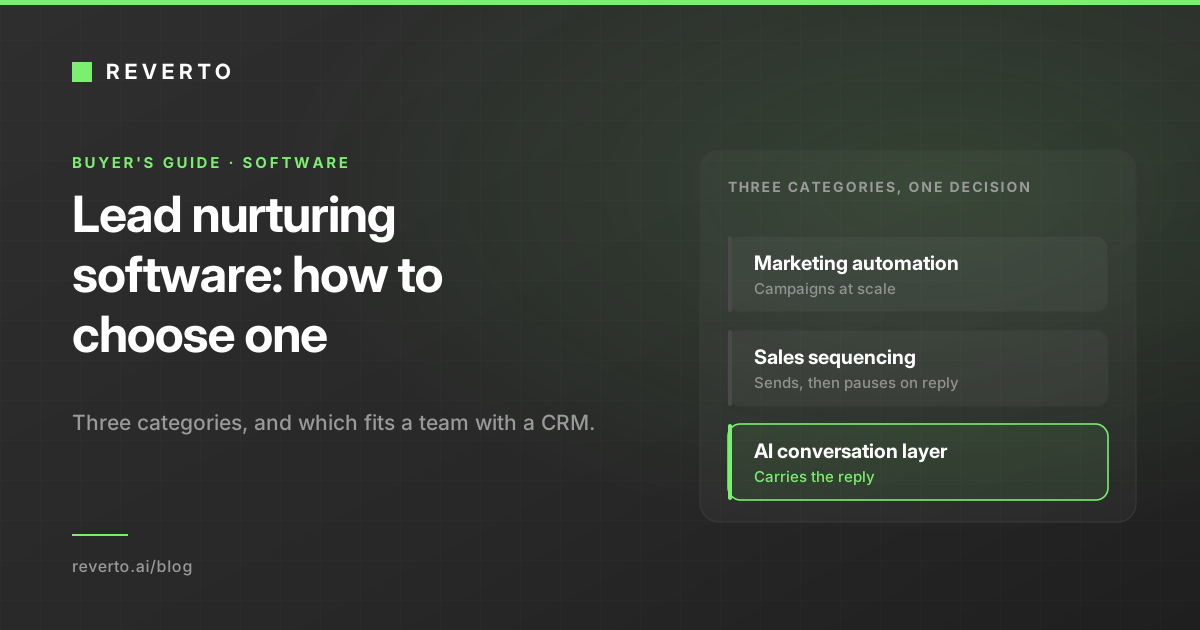
Lead nurturing software falls into three categories that are often compared as if they were one: marketing automation platforms, sales engagement and sequencing tools, and AI conversation layers. They differ less in features than in who operates them and where they stop. The right choice depends on whether your problem is sending messages or answering the replies.
What is lead nurturing software?
Lead nurturing software keeps a lead engaged between the first enquiry and a sales conversation. It schedules and sends follow-up, tracks engagement, and decides what happens next. It works on leads you already have, over time, which is what separates it from prospecting tools and from the CRM itself.
Three terms get blurred here:
- Nurturing works an existing lead over time, from enquiry to conversation.
- Prospecting contacts someone new who has not asked to hear from you.
- A CRM is the record of what happened. It stores the history; it does not, by itself, decide or carry out the next step.
The three kinds of lead nurturing software
The three categories are marketing automation platforms, sales engagement and sequencing tools, and AI conversation layers. Each is built for a different job, is run by a different team, and stops at a different point. The table names examples only to illustrate each category. It is not a ranking.
| Category | Built for | Who operates it | Where it stops | Pricing model |
|---|---|---|---|---|
| Marketing automation platforms (for example HubSpot Marketing Hub and Adobe Marketo Engage) | Scheduled, segmented campaigns at scale | A marketing team | When a reply needs a human answer | Typically per contact |
| Sales engagement and sequencing tools (for example Outreach and Salesloft) | Structured outbound and follow-up cadences | Sales or RevOps | Sequences pause on reply and a rep takes over | Typically per seat |
| AI conversation layers (for example Conversica and Reverto) | Carrying the conversation, including the reply | The buyer's team or the vendor | At an agreed handover point | Per workflow, per conversation or quote-based |
Pricing models change, so check each vendor's own pricing page. Reverto's is on the pricing page.
What should I look for in lead nurturing software?
Look past the feature list to six practical questions: what happens when a lead replies, which contacts it can work, how channels connect, who runs it, what compliance controls exist, and how the price grows. The answers tell you more about fit than any comparison grid of features.
- Does it handle the reply, or only the send? Many tools send well and stop the moment someone answers. If replies are where leads go cold, look for persistent follow-up that carries the conversation, not just the cadence. Our post on how many follow-ups to send before you stop covers the sourced research on follow-up counts.
- Does it work the contacts already in your CRM, or only new ones? Some tools only act on fresh enquiries. Older records need a tool that can read and update what is already there.
- How many channels share one conversation record? Email, SMS, WhatsApp, voice and LinkedIn should add to the same history, so nobody repeats a question the lead has already answered.
- Who configures and maintains it week to week? Every tool needs someone to write messages, adjust rules and review results. Name that person before you buy.
- What are the compliance controls? Check consent records, opt-out handling, quiet hours and A2P registration for business SMS.
- Does pricing scale with your team size or your lead volume? Per-seat pricing grows with headcount; per-contact pricing grows with your list. Timing also matters: see the sourced speed to lead statistics on how response time affects qualification.
Do I need lead nurturing software if I already have a CRM?
A CRM records what happened; nurturing software decides what happens next. Whether you need both depends on whether anyone is acting on what the CRM records. For some teams the honest answer is no, because their CRM's own automation, run consistently, already covers it.
Many teams find the gap is not the tool at all. The CRM has workflows, the sequencer has templates, and leads still sit untouched because nobody has the hours to run them. Buying a second tool does not fix an operating problem. If that is your situation, the question is who will operate the follow-up, not which software to add.
What is AI lead nurturing software, and how is it different?
"AI" in this category means two different things. In some products it writes message copy inside an otherwise fixed sequence. In others it reads what the lead actually said, classifies the intent, and changes what happens next. Both are sold as ai lead nurturing software, so ask which one a vendor means.
Generated copy can make a sequence read better, but the sequence still runs the same steps whatever the lead says. Intent classification is what lets software respond to "call me next month", "send pricing" or "wrong person" differently. It is also what lets a tool keep a conversation going after a reply instead of pausing it. When you compare vendors, ask to see what happens to a real reply.
Lead nurturing software comparison: which category fits which team
The right category depends on where your leads are being lost. Three common situations point to three different answers, and only one of them points to an AI conversation layer. Match your team to the scenario below that sounds most like it before comparing individual products.
A marketing team running campaigns to a large list. The work is segmentation, scheduled sends and reporting across many contacts. A marketing automation platform fits this best. Reverto is not the right choice here.
A sales team with a sequencer whose replies are piling up unanswered. The sending works; the answering does not. An AI conversation layer that carries replies to a handover point fits this gap, alongside the sequencer you already use.
A team whose main loss is dormant records nobody has time to work. Old enquiries and quotes sit in the CRM untouched. This calls for a service or tool that can reactivate dormant leads already in your records. In commercial insurance, for example, this often means old quotes and lapsed renewals in the agency's system.
Best software for b2b lead nurturing
There is no single best software for b2b lead nurturing. The best fit depends on three variables: whether you need the reply handled or only the send, who will operate the tool, and whether pricing should follow headcount or lead volume. A ranked list would hide all three.
Restated plainly: marketing automation platforms suit campaigns to large lists, sales engagement tools suit reps working structured cadences, and AI conversation layers suit teams whose replies or dormant records go unanswered. One thing does not vary between them. Whoever ends up owning the tool has to have time to run it every week.
Where Reverto fits
Reverto is an AI conversation layer delivered as a managed service. The Reverto team builds and operates the workflows for you rather than handing over a platform to configure. It is built around the CRM you already use, so the conversation history stays in your own records.
The workflows cover first response, persistent follow-up, dormant reactivation, qualification, booking and outbound, across email, SMS, WhatsApp, voice and LinkedIn.
Reverto is not for everyone. It does not suit teams who want to configure and own the tool themselves, or teams whose need is broad marketing campaigns rather than lead conversations. For those, a marketing automation platform or a sales engagement tool is the better fit.
Frequently asked questions
What does lead nurturing software do?
Lead nurturing software keeps an existing lead engaged between the first enquiry and a sales conversation. It schedules and sends follow-up, tracks how the lead responds, and decides what should happen next. Depending on the category, it may stop at sending messages, pause when someone replies, or carry the reply itself until the lead is ready for a person to take over.
What should I look for in lead nurturing software?
Check six things: whether it handles the reply or only the send, whether it works the contacts already in your CRM, how many channels share one conversation record, who configures and maintains it each week, what compliance controls it has for consent, opt-out, quiet hours and SMS registration, and whether its pricing scales with your team size or your lead volume.
Do I need lead nurturing software if I already have a CRM?
Not always. A CRM records what happened; nurturing software decides what happens next. If your CRM already has automation and someone has time to run it every week, a second tool may add nothing. If the real gap is that nobody is working the leads, buying software alone will not fix it, because the problem is operating time, not features.
What is the difference between lead nurturing automation software and a sales sequencer?
Lead nurturing automation software, usually a marketing automation platform, sends scheduled, segmented campaigns to large lists and is run by a marketing team. A sales sequencer runs structured follow-up cadences for individual reps and is run by sales or RevOps. Both typically stop when a lead replies: the campaign hands off, and the sequence pauses so a rep can answer.
What is the best software for b2b lead nurturing?
There is no single best tool. Marketing automation platforms suit teams running campaigns to large lists. Sales engagement tools suit reps working structured cadences. AI conversation layers suit teams whose replies or dormant records go unanswered. The deciding variables are whether you need the reply handled, who will operate the tool, and how pricing scales with your team or volume.