REVERTO BLOG
Speed to Lead: What the Response-Time Data Actually Says
What is speed to lead, how fast companies actually respond, and what sourced research shows about response time and conversion.
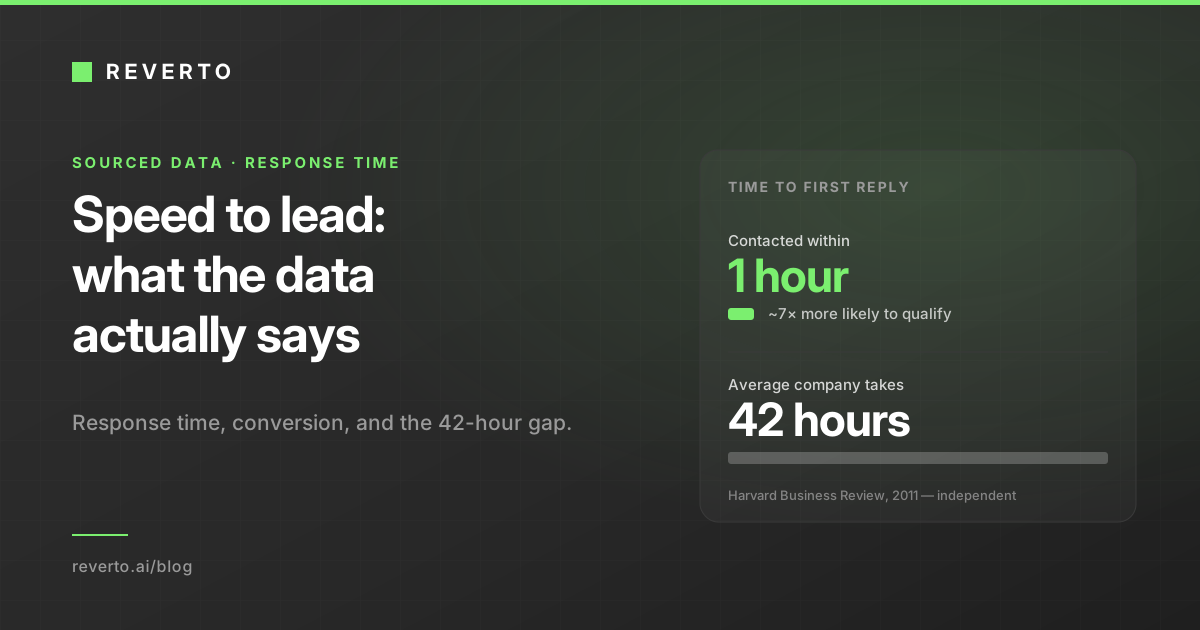
Contacting a new lead within an hour makes it nearly seven times as likely to qualify as contacting it an hour later, according to a Harvard Business Review study published in 2011. The same study found the companies it tested averaged 42 hours to respond to a web lead. Speed to lead matters most on paid and form-generated leads, and it does not fix follow-up that stops after two attempts.
How to read this page. Most response-time research is published by companies that sell sales software. Those figures are marked (vendor-published). Independent, peer-reviewed sources are marked (independent). Every figure on this page links to its publisher.
What is speed to lead?
Speed to lead is the elapsed time between a prospect submitting an enquiry and receiving a genuine reply from a person or system that can advance the conversation. The clock starts at submission, not at the next working day, and for inbound enquiries it is usually measured in minutes rather than hours.
An autoresponder acknowledgement is not a reply. An email that says "thanks, we will be in touch" confirms receipt, but it asks no question, books nothing and moves nothing forward. Speed to lead measures the first response that does.
If an enquiry is answered in seconds by something that can qualify it and book a next step, that is the first reply. If it gets a receipt and then waits for Monday morning, Monday morning is the first reply.
How fast should you respond to a new lead?
Within the hour at the latest, and as close to immediately as you can manage. Harvard Business Review found firms contacting a lead within an hour were nearly seven times as likely to qualify it as firms waiting one hour longer, and more than sixty times as likely as those waiting 24 hours or more.
- Within one hour. Oldroyd, McElheran and Elkington, "The Short Life of Online Sales Leads", Harvard Business Review, March 2011 (independent, peer-reviewed). Firms contacting a lead within an hour were nearly seven times as likely to qualify it as firms waiting one hour longer. Co-author Elkington was CEO of InsideSales.com at the time.
- 24 hours or more. The same study found firms contacting a lead within an hour were more than sixty times as likely to qualify it as those waiting 24 hours or more.
- Within one minute. Velocify data, reported by Solar Power World in October 2015, found calling within one minute raised conversion by 391% (vendor-published, secondary reporting).
How does speed to lead impact revenue generation?
Faster contact raises the share of enquiries that reach a qualified conversation, and qualified conversations are what produce revenue. The effect is indirect. The Harvard Business Review study measured lead qualification, not closed revenue, so it does not show that responding faster multiplies revenue by a fixed amount.
That distinction matters when the study is quoted in sales material. A lead that qualifies still has to be worked, quoted and closed. When a vendor presents the seven-times figure as a revenue claim, it is describing something the study did not measure. The publication details are recorded in the BYU ScholarsArchive entry for the article (independent).
The revenue effect is largest where leads are paid for. Every enquiry from a paid campaign, portal or lead form is spend already committed. When it goes unanswered, that spend produces nothing, and a slow reply lowers the share of paid enquiries that ever reach a qualified conversation.
How fast do companies actually respond?
Slower than the research recommends. The companies tested in the Harvard Business Review study averaged 42 hours to respond to a web lead. In Drift's 2017 test of 433 companies, 7% responded within five minutes and 55% had not responded within five business days.
- 42 hours on average. Companies tested in the Harvard Business Review study averaged 42 hours to respond to a web lead (independent).
- 7% within five minutes; 55% not within five business days. Drift's response-time test of 433 companies, 2017 (vendor-published).
- 13% never contacted. In Velocify's August 2014 secret-shopper study, 13% of enquirers never heard from a sales rep (vendor-published).
These are cross-industry figures. If you handle portal enquiries in real estate or quote requests in commercial insurance, measure your own response time rather than assuming the averages describe you.
What does speed to lead not fix?
It does not fix follow-up that stops early. A fast first reply only helps if the attempts continue after it. Velocify found 93% of converted leads were reached by the sixth call attempt, while InsideSales.com research found reps averaged 1.3 call attempts to a new lead before giving up.
- Six call attempts. Velocify's "The Ultimate Contact Strategy", 2016, covering about 3.5 million leads and summarised by the National Law Review, found 93% of converted leads were reached by the sixth call attempt (vendor-published).
- 1.3 attempts before giving up. InsideSales.com research, cited by Geckoboard, found that between 2008 and 2012 reps averaged 1.3 call attempts to a new lead before giving up (vendor-published, secondary citation).
- Eight touches to a first meeting. RAIN Group's "Top Performance in Sales Prospecting", based on 488 buyers and 489 sellers, reports an average of eight touches to secure a first meeting (vendor-published).
The full breakdown of follow-up counts is in How many follow-ups before you stop?
How do you measure your own response time?
Run a test. Submit an enquiry through each of your own lead sources at three different times: a weekday morning, a weekday evening and a Saturday. Record the time to the first genuine reply, not to the autoresponder. Repeat monthly. Published benchmarks are context; your own number is the one that matters.
- List every lead source: web forms, portals, paid campaigns, chat and phone.
- Submit one test enquiry through each source on a weekday morning, a weekday evening and a Saturday.
- Note the submission time and the time of the first reply that asks a question or offers a next step.
- Ignore automatic acknowledgements when timing the reply.
- Repeat every month and compare the results by source and by time of day.
Where does this data come from?
Every figure on this page comes from one of the eight sources below. Each is linked to the publisher's own page and marked independent or vendor-published, so you can see who produced the research and check the figures yourself before quoting them.
| Source | Year | Type | Used for |
|---|---|---|---|
| Oldroyd, McElheran & Elkington, HBR | 2011 | Independent (peer-reviewed; co-author Elkington was CEO of InsideSales.com) | One-hour and 24-hour findings, 42-hour average |
| BYU ScholarsArchive record | 2011 | Independent | Publication details |
| Drift response-time test | 2017 | Vendor-published | 7% within five minutes; 55% not within five business days |
| Solar Power World on Velocify | 2015 | Secondary reporting of vendor data | 391% first-minute conversion lift |
| Velocify secret-shopper study | 2014 | Vendor-published | 13% never contacted |
| National Law Review summary of Velocify | 2016 | Vendor-published | 93% reached by the sixth call |
| RAIN Group prospecting research | — | Vendor-published | Eight touches to a first meeting |
| Geckoboard citing InsideSales.com | 2008–2012 data | Vendor-published, secondary citation | 1.3 call attempts |
Frequently asked questions
What is speed to lead?
Speed to lead is the time between a prospect submitting an enquiry and receiving a genuine reply from a person or system that can move the conversation forward. The clock starts at submission, not at the next working day. For inbound enquiries it is usually measured in minutes. An automatic acknowledgement that only confirms receipt does not stop the clock.
How fast should you respond to a new sales lead?
Within the hour at the latest. A 2011 Harvard Business Review study found firms contacting a lead within an hour were nearly seven times as likely to qualify it as firms waiting one hour longer, and more than sixty times as likely as those waiting 24 hours or more. Vendor-published Velocify data reports that calling within one minute raised conversion by 391%.
How does speed to lead impact revenue generation?
Indirectly. Faster contact raises the share of enquiries that reach a qualified conversation, and qualified conversations are what produce revenue. The Harvard Business Review study measured qualification, not closed revenue, so treat revenue claims built on it with care. The effect is largest where leads are paid for, because every unanswered enquiry is marketing spend already committed.
Does responding faster actually increase conversion?
The research points that way. Harvard Business Review found leads contacted within an hour were nearly seven times as likely to qualify as those contacted an hour later. Velocify data, reported by Solar Power World, found calling within one minute raised conversion by 391% (vendor-published). Speed works best with persistence: 93% of converted leads in Velocify's data were reached by the sixth call attempt.
What counts as a response — does an autoresponder count?
No. An autoresponder confirms that an enquiry arrived, but it asks no question, books nothing and does not move the conversation forward. Speed to lead measures the first genuine reply from a person or system that can qualify the enquiry or arrange a next step. If the acknowledgement is followed by silence until the next working day, the clock keeps running until that reply.