REVERTO BLOG
B2B Buying Signals: What to Look For in a Reply
The buying signals already in your own conversations: what timing, authority and budget language actually sounds like, and how to tell a real signal from politeness.
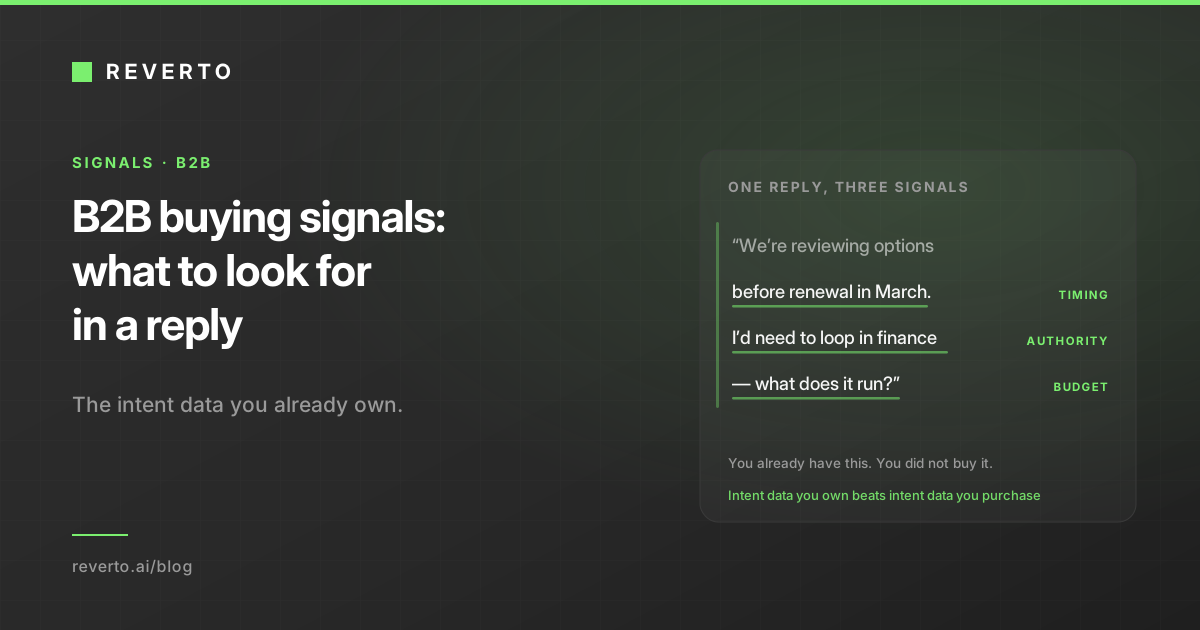
A buying signal is something a prospect says or does that indicates where they are in a decision. Most teams go looking for these in purchased intent data while ignoring the ones sitting in their own inbox: a question about pricing, a renewal date mentioned in passing, a new name added to the thread. Those are the signals you already own, and they tell you what to do next.
What are buying signals?
A buying signal is something a prospect says or does that indicates where they are in a buying decision. Explicit signals are direct, such as a question about price, terms or implementation. Implicit signals come from behaviour: who replies, how fast, and who they copy in. A signal shows position in a decision, never certainty of purchase.
- Explicit signals: "What would this cost for a team of twelve?" or "How long does setup take?"
- Implicit signals: a reply within minutes, a senior colleague copied in, or a forwarded thread that comes back with new questions.
Neither type means a deal will close. Both tell you which conversation to have next.
B2B buying signals: what they sound like in a reply
B2B buying signals in a reply fall into five groups: timing, authority, budget, need and risk. Each group reveals something different about where the prospect stands, and each calls for a different next move. Reading which group a reply belongs to matters more than counting how many signals appear in it.
| Signal | What it sounds like | Right next move |
|---|---|---|
| Timing | "Our contract ends in March." "We plan this at fiscal year end." | Record the date and the reason; schedule contact ahead of it |
| Authority | "I'd need to run this past our ops director." A new name copied in | Offer material the new person can use; ask what they need to decide |
| Budget | "What does this cost?" "Do you offer annual terms?" | Answer plainly; ask what range they planned for |
| Need | A detailed description of their current workaround | Reflect the workaround back; show the specific step you replace |
| Risk | Questions about security, references or implementation | Send the documentation or a concrete implementation outline |
Timing is a date attached to a reason, such as a renewal, a fiscal year or a contract end. A date without a reason is weaker; a reason without a date gives you a question to ask.
Authority shows up when someone new is named or copied in. "I'd need to run this past" means the buyer is building a case internally, so help them build it.
Budget language, such as asking what it costs or asking about terms, means the prospect is checking whether this fits. Avoid a vague answer here.
Need appears when a prospect describes their current workaround in detail. Detail means the problem is real and costing them time.
Risk questions about security, references or implementation usually come late, when the prospect is checking what could go wrong. For B2B services firms, see how this plays out on our B2B services page.
Reading a reply is different from scoring a lead against set criteria. For that, see qualification and routing.
Real-time buying signals vs intent data you buy
Real-time buying signals come from your own conversations; intent data is bought. Third-party intent data infers interest from behaviour elsewhere on the web, such as research activity across many sites, and it is useful for finding accounts you do not know. The trade-off is that it is inferred, and anyone else who buys it sees the same thing.
A reply in your own thread is the opposite on both counts. It is direct, because the prospect wrote it, and it is exclusive, because nobody else can see it. Both have a place. This page is about the second kind: the signals in conversations you are already having.
Sales triggers: events worth acting on
Sales triggers are observable events that give you a reason to get in touch. Useful ones include a funding round, a leadership change, an office move, hiring in a function related to what you sell, and a renewal date you already recorded. A trigger is a reason to write, not evidence that the prospect is interested.
- Funding: new money often means new priorities and budget decisions.
- Leadership change: a new leader often reviews existing suppliers and processes.
- Office move: moves force decisions about systems and suppliers.
- Hiring in a relevant function: shows where the company is investing effort.
- A renewal date you already recorded: the most useful trigger, because you know exactly when to return.
Write with the trigger as context, then let the reply tell you whether there is interest.
What is not a buying signal
Several things look like buying signals and are not. An email open, a content download, a polite reply such as "this looks interesting", and a meeting accepted by someone with no authority are all weak. None of them shows a decision in progress, and each needs something more specific before it counts as a real signal.
- An email open. Privacy features and security scanners can register opens with no human reading. It upgrades to a signal when it leads to a reply.
- A download. People download content to learn, not to buy. It upgrades when followed by a question about their own situation.
- Politeness. "This looks interesting" costs nothing to write. It upgrades when it comes with a date, a name or a question.
- A meeting accepted by someone with no authority. It may be useful research for them. It upgrades when they bring in the person who decides.
Buying intent: how to tell a signal from a brush-off
Buying intent shows up as specifics, and a brush-off avoids them. "Not right now" with a date is a signal: it tells you when to return. "Not right now" without one is usually a no that nobody wants to say. One question separates the two, and asking it politely rarely costs you anything.
The question: "Is there a point in the year when this would be worth revisiting, or should I close the file?"
A prospect with real intent gives a month or an event. A prospect without it usually takes the exit, which is also useful, because it tells you to stop.
What to do when the signal never comes
Most leads produce no signal at all, often because nobody asked enough times for one to appear. A single message rarely draws a clear reply. Signals come from conversations, and conversations need persistence, which is exactly where most sales processes stop well short of the point where buyers typically respond.
InsideSales.com research cited by Geckoboard (vendor-published, secondary citation) found reps averaged 1.3 call attempts before giving up, in data from 2008 to 2012. Velocify's "The Ultimate Contact Strategy" (2016, summarised by the National Law Review, vendor-published) found 93% of converted leads were reached by the sixth call attempt. Speed matters too: the Harvard Business Review study by Oldroyd, McElheran and Elkington (2011, independent; co-author Elkington was CEO of InsideSales.com) found contact within an hour made firms about 7 times more likely to qualify a lead.
The practical answer is to keep the conversation going long enough to earn a reply. See how many follow-ups before you stop, persistent follow-up, and, for records that already went quiet, dormant lead reactivation.
Where Reverto AI fits
Reverto AI is a managed conversion layer that the Reverto AI team operates. It works the leads a company already has and classifies intent from the replies in the conversations it runs. It does not provide third-party intent data. If you need to find accounts you have never spoken to, an intent data product is the better fit.
Where does this data come from?
Every figure on this page comes from the three published sources below, each linked to its publisher. Studies published by companies selling sales software are marked vendor-published. No conversion rate by signal type appears on this page, because none of these sources measures one.
| Source | Year | Type | Used for |
|---|---|---|---|
| Oldroyd, McElheran & Elkington, "The Short Life of Online Sales Leads", Harvard Business Review | 2011 | Independent; co-author Elkington was CEO of InsideSales.com | Within-an-hour contact about 7 times more likely to qualify |
| Velocify, "The Ultimate Contact Strategy", summarised by the National Law Review | 2016 | Vendor-published | 93% of converted leads reached by the sixth call attempt |
| InsideSales.com research, cited by Geckoboard | 2008 to 2012 data | Vendor-published, secondary citation | Reps averaged 1.3 attempts before giving up |
Frequently asked questions
What are buying signals in B2B sales?
Buying signals in B2B sales are things a prospect says or does that show where they are in a decision. Explicit signals are direct, such as a question about pricing or implementation. Implicit signals come from behaviour, such as who replies, how quickly, and who gets copied in. A signal shows position in a decision, not a guaranteed purchase.
What is the difference between buying signals and intent data?
Buying signals come from conversations you are already having: replies, questions and timing language in your own threads. Intent data is a purchased product that infers interest from behaviour elsewhere on the web. Intent data helps you find accounts you do not know yet; a reply is direct evidence, and nobody else who bought the same data can see it.
What are real-time buying signals?
Real-time buying signals are signals that arrive while a conversation is live, such as a reply asking about cost, a renewal date mentioned in passing, or a colleague added to the thread. They matter because they are current and specific to you. Their value fades if nobody acts on them quickly, so the response should follow soon after the signal arrives.
Is an email open a buying signal?
Not on its own. An open shows that an email was displayed, and privacy features and security scanners can trigger opens without a person reading anything. Treat it as weak context at most. It becomes meaningful only when it leads to something a person chose to do, such as a reply, a question or a meeting request.
What is buying intent?
Buying intent is how close a prospect is to making a purchase decision, judged from the evidence available. In a conversation, the strongest evidence is specific: a date attached to a reason, a question about terms, or a decision-maker joining the thread. Vague interest without a date, a name or a question usually shows politeness rather than intent.