REVERTO BLOG
AI Sales Assistant vs AI SDR vs Conversion Layer
Three categories that get compared as if they were one - what each actually does, who has to operate it, and which one fits a team that already has leads.
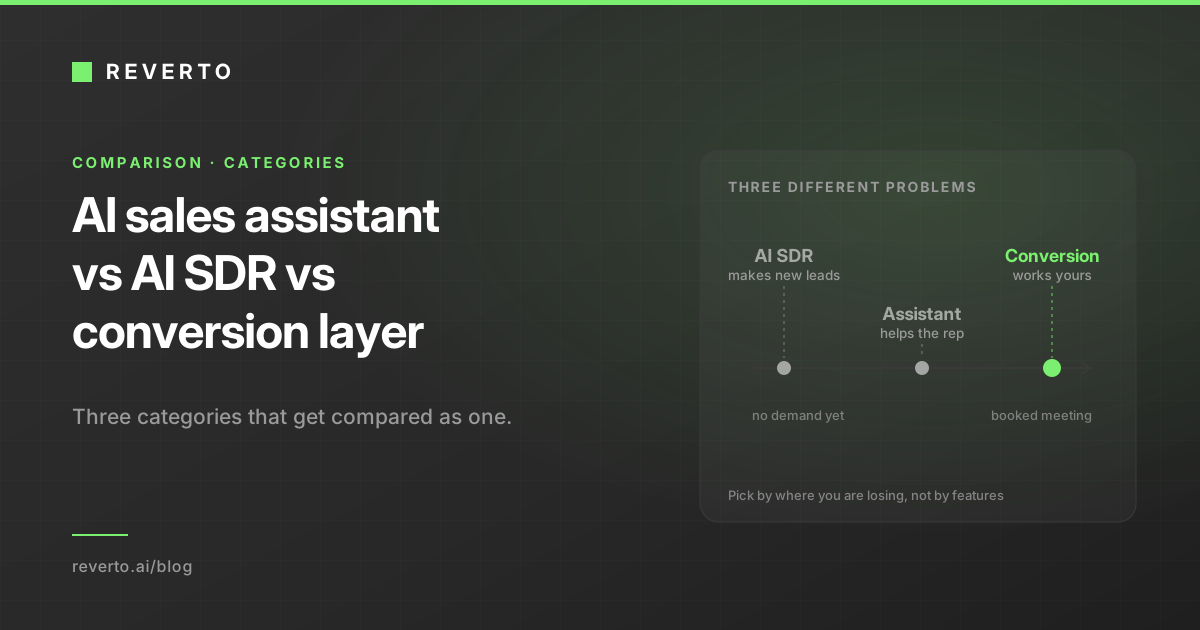
These three get compared as if they were the same product. They are not. An AI sales assistant helps the rep who is already doing the work. An AI SDR generates new pipeline from cold lists. A conversion layer works the leads you already have and carries the conversation through the reply. The right choice depends less on features than on which of those three is actually your problem.
Reverto AI is in the third category, so read the comparison with that in mind. We have named the situations where the other two are the better answer. Figures link to their publishers; vendor-published studies are marked.
What is an AI sales assistant?
An AI sales assistant is software that works alongside a rep inside the tools they already use: drafting emails, summarising calls and accounts, suggesting next steps and updating CRM records. The defining characteristic is that a person is still doing the selling, and the assistant makes that person faster.
It does not decide who to contact or hold conversations on its own. Its value depends on the rep using it, and it stops wherever the rep stops.
What is an AI SDR?
An AI SDR is software that performs the sales development job itself: building a prospect list, sending outbound across channels, handling first replies and booking meetings. The defining characteristic is that it generates new conversations that did not previously exist, usually with people who have not asked to hear from you.
Most vendors use the AI SDR and AI BDR labels interchangeably. For the fuller treatment, including its limits, see what an AI BDR is and what it cannot do.
What is a conversion layer?
A conversion layer is software that works the leads a company already has, new enquiries, stalled deals and dormant records, and carries each conversation through the reply to a booked meeting. The defining characteristic is that it starts from demand that already exists rather than creating new demand, and it handles the response rather than stopping at the send.
The work looks like persistent follow-up: continuing past the point where people usually give up, and answering when the lead writes back.
AI sales assistant comparison: the three side by side
The three categories differ on four questions: who does the selling, where the leads come from, who operates the software and where it stops. The table below sets them side by side without scoring them, because the right choice depends on which problem you have, not on which category has more features.
| Category | What it does | Who does the selling | Where the leads come from | Who operates it | Where it stops |
|---|---|---|---|---|---|
| AI sales assistant | Drafts, summarises, suggests, updates records | The rep | The rep's existing pipeline | The rep | Wherever the rep stops |
| AI SDR | Builds lists, sends outbound, books meetings | The software, until handover | New, cold prospect lists | A sales or ops owner | At the booked meeting or handover |
| Conversion layer | Works existing leads through the reply | The software, until handover | Enquiries and records you already have | An internal owner or a managed team | At the booked meeting or handover |
Which one do I need?
You need the category that matches where revenue is actually lost. Busy reps with enough pipeline need help with admin. A thin top of funnel needs new prospects. Enough enquiries that go cold between touches need someone to keep working them. Most teams can name their problem quickly once it is framed this way.
Busy reps, enough pipeline. A rep team that is busy and slow at admin, but has enough opportunities, is best served by an AI sales assistant.
Not enough pipeline. A team whose problem is not enough pipeline at the top needs an AI SDR. When the need is genuinely net-new prospects, that is the right answer, and a conversion layer will not solve it.
Leads lost between touches. A team that generates enough enquiries but loses them between touches, or has a CRM full of contacts nobody has worked, needs a conversion layer. The gap is real: InsideSales.com research cited by Geckoboard (vendor-published, secondary citation) found reps averaged 1.3 call attempts before giving up between 2008 and 2012, while Velocify's 2016 study of about 3.5 million leads, summarised by the National Law Review (vendor-published), found 93% of converted leads were reached by the sixth call attempt. More on that in how many follow-ups it takes before you stop.
What the best AI sales assistant has in common with the worst one
All three categories share the same limits. None fixes a weak offer, none creates consent to contact someone, none runs itself without an owner, and none has independent published outcome data. The figures available come from the vendors selling each category, so the useful test is your own baseline, measured before and after.
Response time matters across all three. Harvard Business Review research by Oldroyd, McElheran and Elkington (independent; co-author Elkington was CEO of InsideSales.com) found firms contacting a lead within an hour were nearly seven times as likely to qualify it, and the companies studied averaged 42 hours to respond. A 2017 Drift test of 433 companies (vendor-published) found 7% responded within five minutes and 55% had not responded within five business days. RAIN Group (vendor-published) reports an average of eight touches to secure a first meeting. None of these studies measures any of the three software categories.
Measure these four numbers against your own baseline instead:
- Reply rate
- Qualified conversation rate
- Meetings booked
- Opportunities reopened
For long-cycle teams, the same measures apply to B2B lead nurturing over months rather than days.
Can you use more than one?
Yes, and many teams do: an assistant for the reps, plus either outbound or a conversion layer depending on where the loss is. The mistake is buying two tools for the same problem, such as two outbound tools or an assistant and a conversion layer both trying to chase the same stalled deals.
For the tooling question specifically, see what lead nurturing software covers.
Where Reverto AI fits
Reverto AI is a conversion layer, operated as a managed service rather than handed over as a platform; see how the product works. It is not the answer for a team that wants to configure and own the tool itself, and it is not the answer for a team whose real need is net-new pipeline from cold outbound.
Where does this data come from?
Every figure on this page comes from the five published sources below, each linked to its publisher. Studies published by companies selling sales software are marked vendor-published. None of them compares the outcomes of AI sales assistants, AI SDRs or conversion layers, and no independent published data on that comparison exists.
| Source | Year | Type | Used for |
|---|---|---|---|
| Oldroyd, McElheran & Elkington, "The Short Life of Online Sales Leads", Harvard Business Review | 2011 | Independent; co-author Elkington was CEO of InsideSales.com | Within-an-hour contact nearly seven times as likely to qualify; 42-hour average response |
| Velocify, "The Ultimate Contact Strategy", via the National Law Review | 2016 | Vendor-published | 93% of converted leads reached by the sixth call attempt |
| InsideSales.com research, cited by Geckoboard | 2008 to 2012 data | Vendor-published, secondary | Reps averaged 1.3 call attempts before giving up |
| RAIN Group, "Top Performance in Sales Prospecting" | Not stated | Vendor-published | An average of eight touches to secure a first meeting |
| Drift response-time test of 433 companies | 2017 | Vendor-published | 7% responded within five minutes; 55% not within five business days |
Frequently asked questions
What is an AI sales assistant?
An AI sales assistant is software that works alongside a sales rep inside the tools they already use. It drafts emails, summarises calls and accounts, suggests next steps and updates CRM records. The defining point is that a person is still doing the selling. The assistant does not create new conversations or run them on its own; it makes the rep who owns them faster and better organised.
What is an AI SDR?
An AI SDR is software that performs the sales development job itself. It builds a prospect list, sends outbound messages across channels, handles first replies and books meetings. Its defining characteristic is that it generates new conversations that did not previously exist. Most vendors use the AI SDR and AI BDR labels interchangeably, so ask what the software does rather than what it is called.
What is the difference between an AI sales assistant and an AI SDR?
An AI sales assistant helps a human rep who is already selling, by drafting, summarising and updating records. An AI SDR does the prospecting job itself, finding new contacts and starting conversations with them. One makes existing work faster; the other creates new pipeline. A team short on time needs the first, while a team short on prospects needs the second.
Which one do I need?
It depends on where you lose revenue. If reps are busy and slow at admin but have enough pipeline, an AI sales assistant fits. If the real gap is too few prospects at the top, an AI SDR is the honest answer. If you generate enough enquiries but lose them between touches, or your CRM holds contacts nobody works, a conversion layer fits.
Do I need all three?
Rarely. Many teams run an assistant for their reps plus one other tool, either outbound or a conversion layer, depending on whether the loss is at the top of the funnel or between touches. The common mistake is buying two tools for the same problem. Decide where leads are actually lost first, then choose the category that addresses that specific gap.