REVERTO BLOG
What Is an AI BDR - and What It Cannot Do
What an AI BDR actually is, what the category gets right, and the specific things it cannot do - written without a product to sell you.
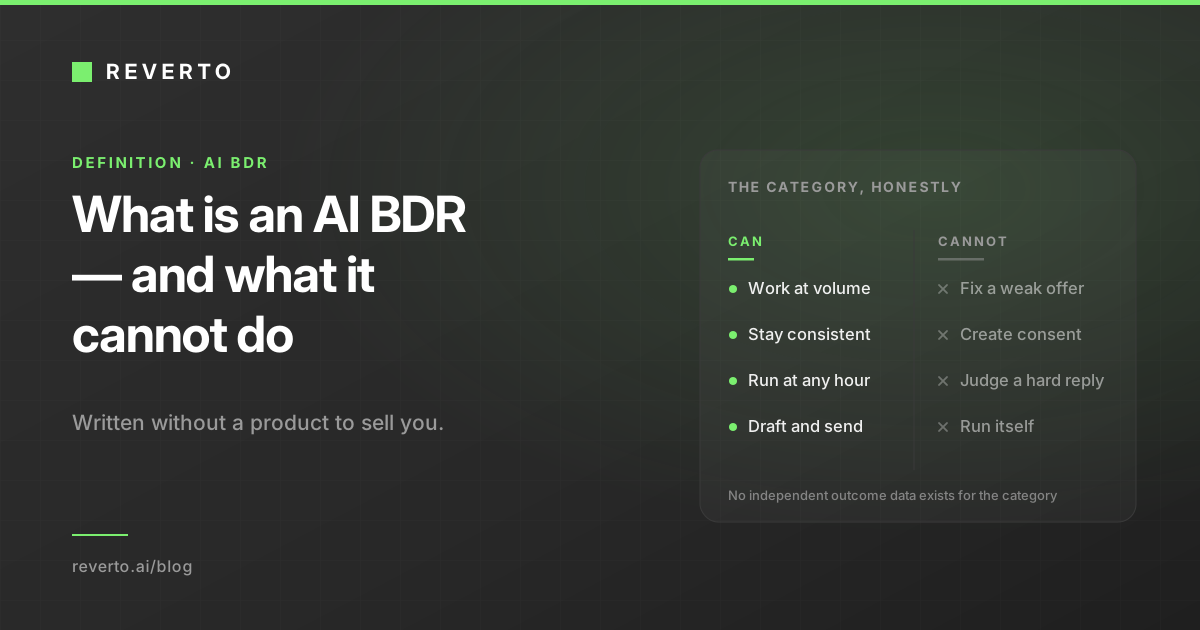
We don't sell an AI BDR. Reverto AI works leads a company already has rather than prospecting new ones, so this page has no product to argue for. Figures below link to their publishers; studies published by companies selling sales software are marked (vendor-published).
An AI BDR is software that does the business development rep's top-of-funnel work: building a target list, writing outbound messages, sending them across channels and handling the early replies. The category is real and the better tools do that job. What they cannot do is fix a weak offer, work a list with no consent record, or replace the judgement a human applies when a deal gets complicated.
What is an AI BDR?
An AI BDR is software that takes on the repeatable parts of a business development rep's job: finding prospects, writing to them and handling the first replies. A human BDR's day is mostly research, outreach and early qualification before handing interested prospects to a salesperson. The software automates most of that sequence, and a person takes over once a conversation becomes real.
The parts the software usually takes on:
- List building: finding companies and contacts that match a defined target profile.
- Enrichment: adding job titles, company details and contact information to each record.
- Message generation: drafting personalised outbound messages from that data.
- Multi-channel sending: sending and sequencing across email, LinkedIn and sometimes phone.
- First-reply handling: reading replies and sorting them into interested, not now, wrong person or unsubscribe.
- Meeting booking: offering times and placing a meeting in a calendar.
The handover to a person usually sits at the point a prospect shows genuine interest, asks something the software is not set up to answer, or reaches a booked meeting.
What is the difference between an AI BDR and an AI SDR?
In practice, very little. The labels follow the human job titles they imitate, and vendors use them interchangeably for software that prospects, sends and handles first replies. Two products with different labels can do identical work, and two products with the same label can do very different work. The useful question is what the software does, not what it is called.
The traditional distinction is that a BDR works outbound, contacting new prospects who have not asked to hear from you, while an SDR qualifies inbound leads who have already enquired. Many companies reverse those meanings, and some use both titles for the same role. When comparing tools, ask which stages each one covers, which channels it sends on and where a person takes over.
How an AI BDR platform actually works
An AI BDR platform runs four stages in sequence: it sources and enriches a list, generates personalised messages, sends them across channels, and then classifies replies to route or book them. The stages sound similar from vendor to vendor. The differences show up in where the list comes from and in how much judgement the reply stage is trusted with.
- Source and enrich a list. The platform pulls contacts that match a target profile and adds firmographic and contact data. Vendors differ widely here, both in data quality and in what record they keep of where each contact came from.
- Generate personalised messages. The software drafts messages using the enriched data. Quality depends on the inputs: thin data produces generic messages, however fluent.
- Send across channels. Messages go out by email, LinkedIn and sometimes phone, on a schedule. How sending volume is ramped and spread across domains is an operational choice, not a feature.
- Classify replies and route or book. The platform sorts replies and either books a meeting, passes the conversation to a person or ends the sequence. This stage differs most between vendors, because it is where the software makes decisions rather than sends messages.
If net-new prospecting is the goal, this is the same ground covered by an outbound prospecting workflow; the question is who runs it and how.
What AI BDR software does well
AI BDR software does some things better than a person can, and a fair assessment has to start there. It covers more contacts than a human could, follows every sequence to the end, responds at any hour, and removes the repetitive list work that eats a BDR's week. Those strengths are real, and they map onto well-documented weaknesses in how human teams follow up.
- Coverage at volume. Software can research and contact far more prospects than a person, without the quality of the hundredth message dropping because it is late in the day.
- Consistency. Human follow-up stops early. InsideSales.com research cited by Geckoboard (vendor-published, secondary citation) found that between 2008 and 2012 reps averaged 1.3 call attempts to a new lead before giving up, while Velocify's 2016 study of about 3.5 million leads (vendor-published) found 93% of converted leads were reached by the sixth call attempt. RAIN Group (vendor-published), surveying 488 buyers and 489 sellers, found an average of eight touches to secure a first meeting, with top performers needing about five. Software does not lose interest after attempt two.
- Tireless availability. Response time matters. Harvard Business Review research (independent) found firms contacting a lead within an hour were nearly seven times as likely to qualify it as firms waiting one hour longer, and the companies tested averaged 42 hours to respond. A 2017 Drift test of 433 companies (vendor-published) found 7% responded within five minutes and 55% had not responded within five business days. More detail is in our speed to lead statistics.
- Removing repetitive list work. Building, cleaning and enriching lists is slow work that software handles well, leaving people more time for conversations.
What an AI BDR agent cannot do
An AI BDR agent automates outreach, but it cannot supply the things outreach depends on: a strong offer, a lawful basis for contacting people, a healthy sending setup, judgement on difficult replies, and someone accountable for results. It also cannot turn a conversion problem into a prospecting one. These six limits matter more than any feature list.
It cannot fix a weak offer
Volume multiplies the message, including a bad one. If the offer does not interest the people on the list, sending it to ten times as many people produces ten times as many people who are not interested, and a larger share of your market that has now heard it.
It cannot create consent
A list with no lawful basis is a legal problem, and software makes it bigger, not smaller. The tool can record where a contact came from, but it cannot give you permission to contact them. That depends on the rules where your prospects are and on how the list was built.
It cannot protect your sending reputation by itself
Domain health, volume ramping and channel registration are operational decisions. A tool can send at whatever rate it is set to; whether that rate damages the domain your whole company emails from is a decision a person has to make and monitor.
It cannot judge a complicated reply
A procurement question, an unusual objection or a message from a sensitive account still needs a person. Classifying a reply as "interested" is not the same as knowing what to say next to someone weighing a large decision.
It cannot run itself
Someone has to own the playbook, read the results and change it weekly. This is the most commonly skipped cost: the tool is bought as a replacement for effort, and then runs unchanged on a sequence nobody is reviewing.
It cannot prospect its way out of a conversion problem
If leads you already paid for go unworked, more new leads does not help. They enter the same process and stall in the same place. Research on how many follow-ups to make before you stop shows how early that stalling usually happens.
Do AI BDRs actually work?
There is no independent, peer-reviewed data on AI BDR outcomes. The figures available come from the vendors selling the category, and vendors do not publish their failures. That does not mean the tools fail; it means the evidence that would settle the question does not yet exist in public, so the honest way to judge one is against your own numbers.
Measure these four numbers against your current baseline:
- Reply rate: the share of contacted prospects who reply at all.
- Qualified conversation rate: the share of replies that become a real conversation with a fitting prospect.
- Meetings booked: meetings that actually take place, not just calendar invitations sent.
- Opportunities created: meetings that turn into a real deal in your pipeline.
Insist on a defined measurement period, agreed in writing before you commit, so that the result is a comparison rather than an impression.
AI BDR tools: what to ask before you buy
The questions that separate AI BDR tools are about operation, not features. Before buying, ask who runs it, where its list comes from, what it does when it is unsure and what it writes back to your CRM. Answers to these eight questions reveal more than a demo, because a demo shows the best-case conversation.
- Does it handle the reply, or only the send?
- Where does the list come from, and what is the consent record for each contact?
- Who operates it week to week, and how many hours does that take?
- What happens when it is unsure how to answer a reply?
- What is written back to the CRM, and on which record?
- How is sending volume ramped, and across which domains?
- What happens to leads it cannot qualify?
- What does success look like, in writing, before we start?
When an AI BDR is the wrong tool
An AI BDR is the wrong tool when the problem is conversion rather than prospecting. For how it compares with the other two categories, see AI sales assistant vs AI SDR vs conversion layer. If enquiries go unanswered, follow-up stops after two attempts, or the CRM is full of contacts nobody has touched, the leads already exist. Adding more outbound volume feeds the same process that is already dropping them, so it will not solve the problem.
The fix there is working the leads you have: answering new enquiries quickly, continuing follow-up well past the second attempt, and going back to old records. The evidence on how many follow-ups it takes and the approach to dormant lead reactivation cover that ground. For B2B services firms with long sales cycles, the stalled proposal is often a better place to start than a cold list.
Where Reverto AI fits
Reverto AI is a managed conversion layer, not a prospecting agent. It works the leads a company already has, new enquiries, stalled deals and dormant records, rather than prospecting new ones, and the Reverto AI team operates it rather than handing over a platform. For companies whose actual need is net-new pipeline from cold lists, an outbound tool is the better fit.
Where does this data come from?
Every figure on this page comes from the five published sources below, each linked to its publisher. Studies published by companies selling sales software are marked (vendor-published); the independent study is marked (independent). None of these sources measures AI BDR performance, and no AI BDR performance figure appears on this page.
| Source | Year | Type | Used for |
|---|---|---|---|
| Oldroyd, McElheran & Elkington, "The Short Life of Online Sales Leads", Harvard Business Review | 2011 | Independent; co-author Elkington was CEO of InsideSales.com | Within-an-hour qualification finding and the 42-hour average response |
| Velocify, "The Ultimate Contact Strategy", summarised by the National Law Review | 2016 | Vendor-published | 93% of converted leads reached by the sixth call attempt |
| InsideSales.com research, cited by Geckoboard | 2008 to 2012 data | Vendor-published, secondary citation | The 1.3 call attempts figure |
| RAIN Group, "Top Performance in Sales Prospecting" | Not stated | Vendor-published | Eight touches to a first meeting; about five for top performers |
| Drift response-time test of 433 companies | 2017 | Vendor-published | 7% responded within five minutes; 55% had not responded within five business days |
Frequently asked questions
What is an AI BDR?
An AI BDR is software that performs the top-of-funnel work of a business development rep: building target lists, enriching contacts, writing outbound messages, sending them across email, LinkedIn and sometimes phone, and handling early replies. Most tools hand a conversation to a person once a prospect shows real interest or asks something the software cannot answer. The label describes the job it imitates, not a single standard product.
What is the difference between an AI BDR and an AI SDR?
In practice, very little. The labels follow human job titles, and vendors use them interchangeably. Traditionally a BDR prospects new outbound accounts while an SDR qualifies inbound leads, though many companies reverse those meanings. Two products with different labels can do the same work, so ask what the software actually does, which stages it covers and where a person takes over.
Do AI BDRs actually work?
There is no independent, peer-reviewed data on AI BDR outcomes. The figures available come from the vendors selling the category, and vendors do not publish their failures. The practical answer is to test one against your own baseline: measure reply rate, qualified conversation rate, meetings booked and opportunities created over a defined period agreed in writing before you commit.
Can an AI BDR replace a human BDR?
It can replace much of the repetitive work, such as list building, first drafts and sending at volume, but not the whole role. Someone still has to own the offer, the playbook, the consent record and the sending setup, and a person still needs to handle complicated replies and sensitive accounts. Most teams that use one change what the human does rather than removing the human.
How much does AI BDR software cost?
Pricing follows a few common models: per seat, per contact, per meeting booked, or quote-based contracts that bundle setup and usage. Published prices change too often to quote reliably, so check each vendor's own pricing page and ask what is included. Also count the operating time someone on your team will spend running the tool, which rarely appears on a price list.