REVERTO BLOG
Lead qualification: what BANT was built for, and a checklist that fits service businesses
Lead qualification decides which enquiries get a person's time. What BANT, MEDDIC and GPCT were built for, and a six-question checklist for service businesses.
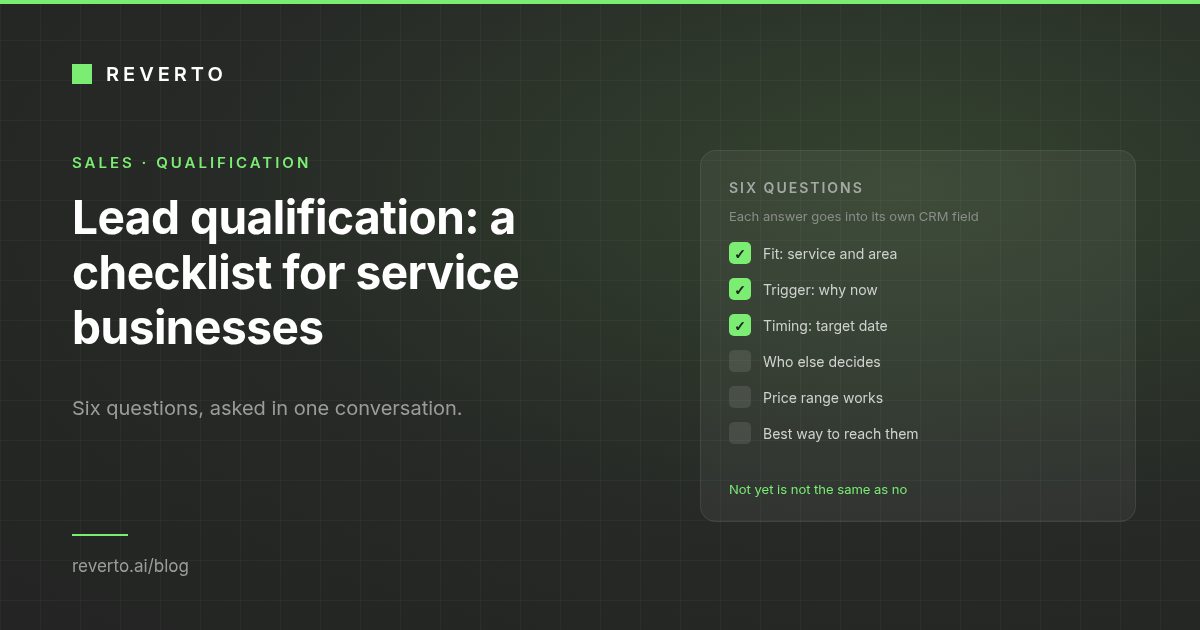
Lead qualification is the process of deciding whether an enquiry deserves a salesperson's time: does it fit what you sell, is the need real, is the timing close enough to act on, and is the person able to decide. In a service business it is mostly one short conversation, and the first job is making sure that conversation actually happens.
Reverto AI is in the managed follow-up category, so read this with that in mind. We have named the situations where a framework, a web form or your own team is the better answer. Figures link to their publishers; vendor-published sources are marked.
What is lead qualification?
Lead qualification is the step between "someone got in touch" and "a salesperson spends time on this". It checks fit, need, timing and decision-making before the expensive part of selling starts. There is no single industry standard for the stages, so the useful definition is the one your team writes down and records the same way in your CRM.
Vendors broadly agree on the idea and disagree on the labels. Salesforce's guide to lead qualification (vendor-published, updated 2025) says two main factors decide it: the product will meet the buyer's need, and the buyer can afford it. It also says the meaning of a marketing qualified lead (MQL) and a sales qualified lead (SQL) depends on how each company uses the terms. Highspot's 2026 checklist (vendor-published) defines an SQL as fully vetted by sales, with confirmed need, timing and decision-making power, and adds a sales accepted lead stage in between.
Two vendors, two stage definitions. Pick plain ones and write them down.
| Stage | Plain definition for a service business | Who decides |
|---|---|---|
| Enquiry | Someone has asked about a service | Nobody yet |
| Contacted | A real two-way conversation has started | The person or system that replied |
| Qualified | Fit, need, timing and decision-maker confirmed | Your agreed criteria |
| Not yet | Fits, but timing is months away | Your agreed criteria |
| Not a fit | Wrong service, area or size | Your agreed criteria |
How do you qualify a sales lead?
You qualify a sales lead by reaching the person quickly, confirming the request fits what you do, understanding what prompted it and when it needs to happen, finding out who else decides, and recording the answers where your team will see them. The order matters: none of the later steps happen if the first reply is late.
- Reply first. A lead that never hears back cannot be qualified or disqualified. Our speed to lead review covers what the response-time research shows.
- Confirm fit. A service you offer, in an area you cover, at a size you take on.
- Understand the trigger and timing. A renewal date, a failed boiler or a house move tells you more than "within six months".
- Find out who decides. A spouse, a partner or a board. The aim is the right people in the next conversation, not filtering people out.
- Record and route. Write each answer into a named CRM field, not a free-text note. Our CRM hygiene guide explains why unstructured notes stop converting.
- Decide what happens to "not yet". A lead that fits but is not ready belongs in persistent follow-up, not closed.
Where did BANT come from, and what was it built for?
BANT (budget, authority, need, timeframe) is widely credited to IBM. We could not find an IBM document saying when or by whom it was created. What we did find are IBM's own BANT forms from 2008 and 2009, and they show BANT working as an eligibility check for enterprise software deals in a partner incentive programme.
We opened three BANT templates that IBM still hosts on its public file server and compared what each required. All three are forms an IBM business partner filled in when registering an opportunity, not a sales training method.
| IBM document | Date shown | Programme | What it required |
|---|---|---|---|
| BANT Criteria Template v3.4 (primary) | November 2008 | Software Value Incentive, North America | At least one customer C-level or line-of-business executive; procurement contacts "not valid"; close date at least 15 days after submission |
| BANT Criteria Template v5.0 (primary) | November 2009 | Software Value Incentive, North America | As above, plus a description of how the budget will be approved and the key decision milestones; only opportunities at sales stage 4 or higher |
| BANT template v1.1, EMEA (primary) | Undated | Value Advantage Plus for Government Sales | Only validated opportunities where the partner has made at least one sales call; budget, authority and timeframe entered in IBM's partner portal |
Three things stand out. First, "authority" meant an executive at the customer, with purchasing staff explicitly excluded. Second, "timeframe" was a forecast decision date in a system, with a 15-day minimum, not a judgement about how ready the buyer felt. Third, BANT was applied after a sales call had already happened, as proof the deal was real enough to earn a partner incentive.
That is a sensible tool for an IBM reseller and a poor gate for a family asking about a roof or a practice asking about insurance cover. Those buyers are usually the authority, cannot name a budget for something they have never bought, and are qualified by their trigger.
Which lead qualification framework should you use?
Use the framework that matches who is buying. Committee-style frameworks such as MEDDIC suit complex deals with several decision-makers. Owner-led service businesses usually need something shorter: fit, trigger, timing, decision-maker and a price-range check, asked in the first conversation and recorded the same way every time.
The scale gap is real. Gartner's 2025 survey of 632 B2B buyers (independent analyst survey) describes buying groups ranging from five to 16 people across as many as four functions. Frameworks built for that world ask different questions from the ones a service enquiry needs.
| Framework | What the letters cover | Origin, as sourced | Built for | Fit for an owner-led service business |
|---|---|---|---|---|
| BANT | Budget, authority, need, timeframe | IBM partner forms, 2008 to 2009 (primary); no creation date found | Registering enterprise software deals | Useful checklist, poor gate |
| MEDDIC | Metrics, economic buyer, decision criteria, decision process, identify pain, champion | Created at PTC in 1996, per MEDDICC Ltd (vendor-published, sells MEDDIC training) | Complex B2B deals with buying committees | Too heavy for most enquiries |
| GPCTBA/C&I | Goals, plans, challenges, timeline, budget, authority, negative consequences, positive implications | Developed internally by HubSpot, per HubSpot's own blog (vendor-published) | Exploratory calls with informed B2B buyers | Good questions, long for a first reply |
| CHAMP | Challenges, authority, money, prioritisation | We could not trace a primary origin | Consultative B2B selling | Close to useful; leads with the problem |
| Six-question checklist (below) | Fit, trigger, timing, decision, price range, contact | This article | Service enquiries answered in one conversation | Designed for it |
HubSpot argues that buyers now arrive better informed, with reps holding less control over the decision. That applies to service buyers too, so lead with their trigger, not your budget question.
What questions should you ask to qualify a lead?
Ask six things in plain language: is this something we do, what prompted it, when does it need to happen, who else is involved, does our usual price range work, and how should we stay in touch. Each answer goes into its own CRM field, so anyone can see why a lead was qualified or parked.
| # | Question to ask | What it tells you | Park or decline if | CRM field |
|---|---|---|---|---|
| 1 | "What can we help with, and where is it?" | Fit: service, location, size | Not a service you offer or outside your area | Service type, location |
| 2 | "What made you look into this now?" | The trigger, the strongest signal of intent | No trigger and no urgency (park, do not decline) | Trigger |
| 3 | "When would you ideally like this sorted?" | Timing | More than your nurture window away (park) | Target date |
| 4 | "Is anyone else involved in deciding?" | Who needs to be in the next conversation | Never a reason to decline on its own | Decision-makers |
| 5 | "Jobs like this usually run between X and Y. Does that work for you?" | Budget, without asking for a number | Clearly far below your minimum | Price range confirmed |
| 6 | "What is the best way and time to reach you, and is it all right to text?" | Contactability and permission | They ask not to be contacted | Preferred channel, consent note |
Question 6 is also a compliance step. If you text or call leads, record when and how permission was given and honour opt-outs. Not legal advice: rules on calls and texts vary by channel, state and purpose, so check your process with your own counsel.
Our guide to B2B buying signals covers what timing, authority and budget language sounds like in a reply.
Our take: most leads marked unqualified were never asked
In owner-led service businesses, poor lead quality is usually a follow-up problem wearing a qualification label. Enquiries wait days for a reply, many never answer, and the CRM records them as junk. Nobody asked the questions, so nobody knows whether they would have qualified.
This view rests on the IBM documents above (BANT was applied after a sales call, not instead of one), on the definitions from the vendors we read, and on the illustrative arithmetic below. It does not rest on Reverto customer data. The researchers behind the Harvard Business Review study of online lead response (independent, 2011; one co-author worked at InsideSales) summarised their audit simply: most companies are not responding nearly fast enough.
Illustrative. A home services firm receives 120 enquiries in a month. The numbers are invented to show the arithmetic, not taken from any client.
| Outcome | Enquiries | What the CRM usually says | What you actually know |
|---|---|---|---|
| Reached, qualified | 30 | Qualified | Qualified |
| Reached, not a fit | 20 | Unqualified | Unqualified |
| Reached, not yet | 25 | Unqualified or lost | A future customer with a date |
| Never reached | 45 | Unqualified or junk | Nothing at all |
On paper this firm qualifies 25% of its enquiries (30 of 120) and concludes its leads are poor. On the facts, it qualified 30 of the 75 people it actually spoke to, 40%, and has no information on the other 45. If the never-reached group qualified at the same 40%, that would be 18 more qualified conversations a month, sitting in a field marked "junk". The fix is not a better framework. It is making sure every enquiry gets asked.
How do chatbots and AI qualify leads?
Chatbots and AI systems qualify leads by asking a fixed set of approved questions, interpreting the replies, writing the answers to the lead record and routing the result. They are consistent and available at any hour. They are only as good as the criteria you give them, and they need a person behind them for edge cases.
Before any system qualifies on your behalf, check five things: the questions are yours and approved before sending; answers land in CRM fields your team already uses; a person takes over when a lead asks something unusual or wants a human; "qualified" means your written criteria, with the reason visible; and you can pause it and see every message sent.
Key takeaways
- Lead qualification checks fit, need, timing and decision-making, but it only works if the qualifying conversation actually happens.
- In the IBM documents we found, BANT was an eligibility form for enterprise software deals, applied after a sales call. It is a fair memory aid and a poor gate for service enquiries.
- Six plain questions, recorded in named CRM fields, will qualify most service enquiries in one conversation and keep "not yet" leads alive.
Where Reverto AI fits
Reverto AI is a managed follow-up service. Our team answers new enquiries, asks the qualifying questions you approve across email, SMS, WhatsApp, voice and LinkedIn, records the answers inside your existing CRM and hands qualified conversations to your team, who keep the close. Leads that are "not yet" stay in follow-up rather than being closed.
Reverto is the wrong choice if you receive fewer than about 100 enquiries a month and someone on your team already replies to each one the same day; a shared checklist like the one above will serve you well. It is also the wrong choice for enterprise deals where an account executive running MEDDIC-style discovery with a buying committee is the work itself, or if you want self-serve software to configure on your own.
Where does this data come from?
Every external figure and claim in this article links to the page we opened when writing it in November 2026.
| Source | Year | Type | Used for |
|---|---|---|---|
| Salesforce, What is lead qualification | 2024, updated 2025 | Vendor-published | Definition; MQL and SQL vary by company |
| Highspot, Lead qualification process checklist | 2025, updated 2026 | Vendor-published | SQL definition and sales accepted lead stage |
| IBM BANT Criteria Template v3.4 | 2008 | Primary | What IBM's BANT form required |
| IBM BANT Criteria Template v5.0 | 2009 | Primary | What IBM's BANT form required |
| IBM BANT template v1.1, EMEA | Undated | Primary | At least one sales call before registration |
| MEDDICC Ltd, Who created MEDDIC | 2026 | Vendor-published | MEDDIC origin at PTC, 1996 |
| HubSpot, GPCTBA/C&I framework | 2025 | Vendor-published | GPCTBA/C&I letters and reasoning |
| Gartner sales survey press release | 2025 | Independent analyst survey | Buying groups of five to 16 people |
| Harvard Business Review, The Short Life of Online Sales Leads | 2011 | Independent | Most companies respond too slowly |
Frequently asked questions
What is the difference between lead qualification and lead scoring?
Lead scoring ranks leads automatically from data such as page visits, form fields and email clicks. Lead qualification is the judgement that a specific enquiry fits, has a real need and is worth a salesperson's time, usually confirmed in a conversation. Scoring decides who to call first. Qualification decides what happens after the call.
Should you ask a lead about budget on the first call?
In most service businesses, not directly. Asking a homeowner or a small business owner for their budget early tends to produce a guess or a defensive answer. It works better to share your typical price range and ask whether it fits. That tests budget without making the lead feel priced before they feel understood.
How long should lead qualification take for a service business?
For most enquiries, a few minutes of conversation is enough: what they need, where, when, and who decides. The longer part is reaching them at all. Qualification that waits days for a callback often ends with no answer, and the lead gets marked as poor quality when nobody actually asked the questions.
Is BANT still useful?
As a memory aid, yes. Budget, authority, need and timing are fair things to understand about any buyer. The problem is using it as a gate. IBM's own BANT forms were built to check enterprise software deals for a partner incentive, so applied rigidly to a small service enquiry it screens out buyers who are simply early.
Can AI qualify leads without a person?
AI can ask approved questions, interpret the replies, record the answers and route the conversation, which covers much of the routine work. It should not invent its own criteria or make judgement calls the business has not defined. A person should set the questions, review edge cases and take over when the conversation needs one.