REVERTO BLOG
Lead Nurturing Emails That Get a Reply
What to send a lead who is not ready yet: the four parts of a nurture email that earns a response, and examples for the five situations that come up most.
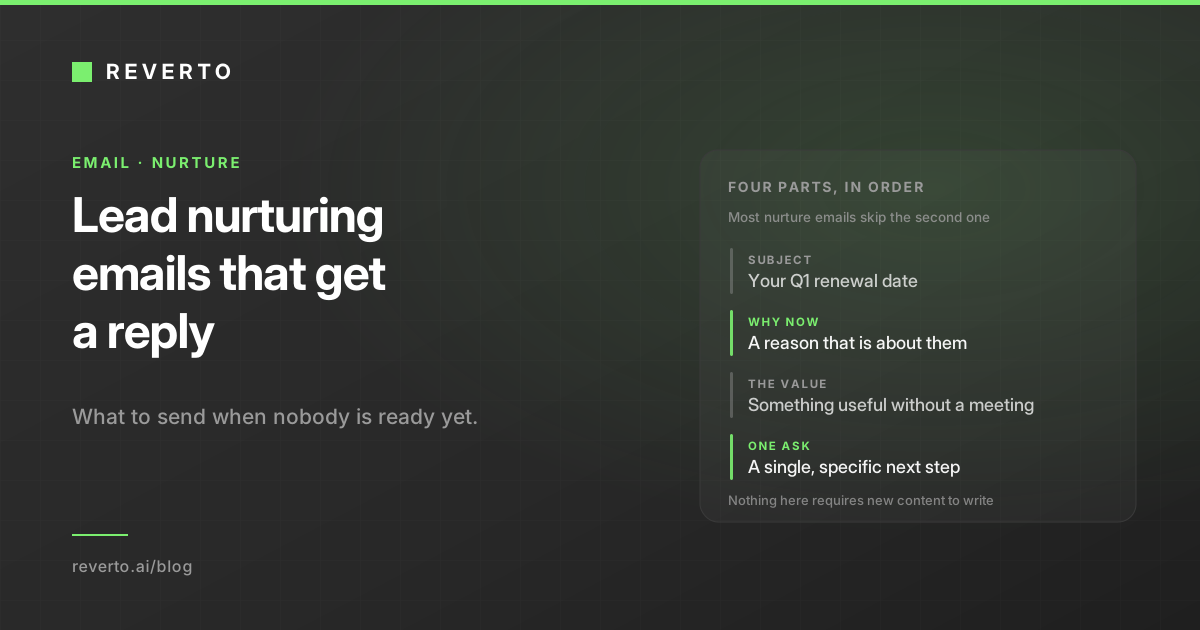
A lead nurturing email works when it gives the reader a reason to reply that is about them, not about your pipeline. Most nurture sequences fail on the second of four parts. They have a subject, some value and an ask, but no reason why this email is arriving today. Without that reason, the email reads like a scheduled touch, because that is exactly what it is.
What is a lead nurturing email?
A lead nurturing email is a message to someone who has already shown interest but is not ready to buy, sent to keep the conversation alive until they are. The reader asked about something once. The email's job is to stay useful and relevant until the timing on their side changes, without pushing for a decision they are not ready to make.
It sits between two other kinds of email:
- Cold outreach goes to people who have shown no prior interest.
- Follow-up on a live deal moves an active conversation forward after a call, quote or meeting. It is shorter and more urgent. Templates for that are in sales follow-up email templates.
The four parts of a nurture email that gets a reply
A nurture email that earns a reply has four parts: a subject, a reason why now, something of value, and one ask. Each part has a single job. Most emails manage three of the four. The one they skip is "why now", and that missing reason is usually what makes a careful email feel automated to the person reading it.
- Subject. Names something specific to the reader: their renewal, their market, the thing they asked about. Not your product.
- Why now. A reason this email is arriving today that is specific to them: a date they mentioned, a change in their market, a new person on the account.
- The value. Something useful that does not require a meeting first: a checklist, a short answer, a relevant change they may have missed.
- One ask. A single, specific question that is easy to answer. Not three options, and not "let me know your thoughts".
"Why now" is the part most sequences skip, because it takes work. A scheduled email can be written once and sent to everyone. A reason has to be found for each person. When it is missing, the reader can tell the email would have arrived regardless of anything they did or said, and they treat it accordingly.
Lead nurturing email examples
These five lead nurturing email examples cover the situations that come up most often. Each has a real reason for its timing built in. Replace every [bracketed] placeholder with something specific; if you cannot fill a placeholder honestly, that is a sign the email should not be sent yet. No figures are attached to these examples, because no source measures them.
A renewal or contract date you already know about
Subject: Your [policy/contract] renews in [month]

Hi [first name],

When we spoke in [month], you mentioned your [contract] with
[current provider] runs until [date]. That is about [number]
weeks away.

Here is the short list of things worth checking before it
renews: [one-line checklist or link].

Would it help to compare options before [date], or are you
planning to stay put this year?
What to change: use the date they gave you, not a guess.
Something changed in their market
Subject: [Change] and your [thing they enquired about]

Hi [first name],

[Specific change, e.g. a rule, price or deadline] came into
effect on [date]. It affects [the thing they asked about]
because [one sentence].

Here is what it means in practice: [two lines].

Is this something you are already planning for?
What to change: only send this if the change genuinely affects what they asked about.
"Not this quarter" and the quarter has turned
Subject: Back in [month], as you suggested

Hi [first name],

In [month] you said [topic] was not a priority until
[quarter]. It is now [quarter], so I am checking in as
agreed.

Since then, [one useful update relevant to them].

Is it still on the list for this quarter?
What to change: quote the reason they gave, in their words if you have them.
A new person joined the thread or took over the account
Subject: [Topic] — picking up from [previous contact]

Hi [first name],

[Previous contact] and I were talking about [topic] until
[month]. I understand you now look after [area].

The short version of where things stood: [two lines].

Would it be useful to have the summary, or is this no
longer a priority on your side?
What to change: give the new person the context; do not make them ask for it.
They downloaded or asked about something specific and went quiet
Subject: The [guide/question] you asked about

Hi [first name],

You [downloaded / asked about] [specific thing] in [month].
The question people usually have next is [follow-on
question], so here is the short answer: [two lines].

Did that cover what you were looking for?
What to change: answer the next question for them, rather than asking for a call.
What makes a nurture email get ignored
Nurture emails get ignored for a small number of reasons, and most of them are visible to the reader within a few seconds. The common thread is that the email is about the sender's needs rather than the reader's. Four failure modes cover most of the emails that never get a reply.
- No reason for the timing. The email could have arrived any week, so it does not matter which week it did.
- An ask that needs a meeting before any value. "Can we jump on a call?" asks the reader to pay first.
- Content about you. Product news, awards and feature launches answer a question the reader did not ask.
- A schedule the reader can feel. Same day, same time, same shape every few weeks reads as a sequence, not a person.
Nurture email sequence: how to space them
In a nurture email sequence, spacing matters less than whether each email has its own reason. A well-timed email with no reason is still easy to ignore. That said, the research on contact attempts is clear on one point: most teams stop well before persistence has a chance to work, so the bigger risk is sending too few, not too many.
Velocify's "The Ultimate Contact Strategy" (2016, summarised by the National Law Review, vendor-published) found 93% of converted leads were reached by the sixth call attempt. Against that, InsideSales.com research cited by Geckoboard (vendor-published, secondary citation) found reps averaged 1.3 attempts before giving up, in data from 2008 to 2012. Both measure calls rather than emails, so treat them as a guide to persistence, not an email schedule.
For the full traced numbers on attempt counts, see how many follow-ups before you stop. For why the first response matters so much, see speed to lead statistics. For long buying cycles where nurture runs for months, see B2B lead nurturing.
How long should a nurture sequence run?
A nurture sequence should run until there is a reason to stop, not until it reaches a count. Three things end it: an explicit no, an opt-out, or a confirmed change that removes the need, such as buying elsewhere or the project being cancelled. Anything short of those means the person is still a lead who is not ready yet.
Stopping on a count is how leads end up dormant. A sequence that ends after a fixed number of emails leaves people who never said no sitting in the CRM untouched. Working that group later is what dormant lead reactivation is for. In fields with long renewal cycles, such as commercial insurance, a lead can stay valid for a year or more.
Where Reverto AI fits
Reverto AI is a managed conversion layer, run by the Reverto AI team, that works the leads a company already has. Its persistent follow-up workflow writes each message around a reason specific to the lead and stops on a reply, a no or an opt-out. It is not an email marketing tool for newsletters or broadcasts. If that is what you need, use one.
Where does this data come from?
Every figure on this page comes from the published sources below, each linked to its publisher. Studies published by companies selling sales software are marked vendor-published. No email performance figures, such as how often a template is opened or answered, appear on this page, because none of these sources measures them.
| Source | Year | Type | Used for |
|---|---|---|---|
| Velocify, "The Ultimate Contact Strategy", summarised by the National Law Review | 2016 | Vendor-published | 93% of converted leads reached by the sixth call attempt |
| InsideSales.com research, cited by Geckoboard | 2008 to 2012 data | Vendor-published, secondary citation | Reps averaged 1.3 attempts before giving up |
Frequently asked questions
What is a lead nurturing email?
A lead nurturing email is a message to someone who has already shown interest but is not ready to buy, sent to keep the conversation alive until they are. It differs from cold outreach, which goes to people with no prior interest, and from follow-up on a live deal, which is shorter and more urgent.
What should a lead nurturing email say?
It should say four things: a subject that names something specific to the reader, a reason the email is arriving today, something useful that does not need a meeting, and one clear ask. The part most emails leave out is the reason for the timing, which is why so many read like scheduled touches.
How often should you send nurture emails?
Send one when you have a real reason to, rather than on a fixed calendar. Research on contact attempts shows persistence matters, and most teams stop far too early, but spacing matters less than whether each email has its own reason. An email with no reason for its timing is easy to ignore, however well spaced.
What is the difference between a nurture email and a follow-up email?
A follow-up email moves a live conversation forward, usually after a call, quote or meeting, and is short and urgent. A nurture email goes to someone who is not ready yet. It keeps the relationship useful over weeks or months, without pushing for a decision the reader has already said is not due.
How long should a nurture email be?
Short enough to read on a phone without scrolling: usually three to six sentences. It needs room for a reason, one useful thing and one ask, and nothing else. Long nurture emails tend to drift into talking about the sender, which is the fastest way to make a reader stop opening them.